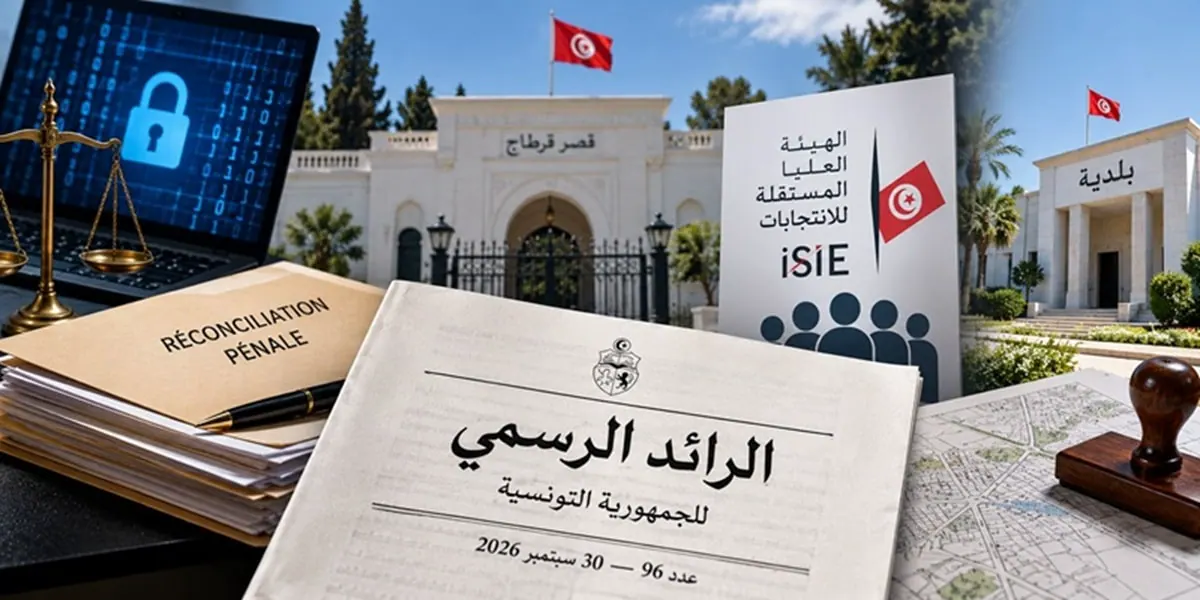
The Tunisian government has published four decrees in the Official Gazette, following a Council of Ministers meeting on September 29. These decrees aim to reform the country's electoral body, penal reconciliation process, and municipal framework. The decrees were announced after the Council of Ministers meeting, with details to be revealed later. The publication of these decrees provides insight into the government's plans for reform.
One of the decrees, decree-law 54, modifies article 24 of the existing decree-law. The new article 24 eliminates prison sentences for first-time offenders, replacing them with fines ranging from 10,000 to 20,000 dinars. In cases of recidivism, the decree-law prescribes six months of imprisonment and a 50,000-dinar fine. The penalties are doubled if the offender is a public official or equivalent.
The decree-law on penal reconciliation, decree-law 2026-2, introduces significant changes. The new article 25 allows the National Commission for Penal Reconciliation to establish a provisional reconciliation project based on payment of at least 50% of the due amounts. The applicant must commit to paying the remaining amount within a fixed period, not exceeding two years. The commission can propose a lower rate than 50% if justified.
The structure and mandate of the Independent Higher Instance for Elections (ISIE) have been modified through decree-law 2026-3. The ISIE Council will now consist of nine members, with three chosen by the President of the Republic from individuals with at least ten years of experience in administration, organization, or election supervision. Three other members will be magistrates from different judicial orders, each with at least ten years of seniority.
The ISIE Council will also comprise an engineer specializing in electoral processes and information technology. The members will serve six-year terms. The changes aim to ensure the independence and impartiality of the electoral body. The new structure is expected to enhance the transparency and credibility of the electoral process.
The decrees also introduce a new framework for municipal councils. This framework is expected to redefine the role and responsibilities of municipal councils, enhancing their autonomy and efficiency. The government has not provided detailed information on the new framework, but it is expected to be implemented soon.
The implementation of these decrees is expected to have a significant impact on Tunisia's democratic process. The reforms aim to enhance transparency, accountability, and efficiency in the electoral process, penal reconciliation, and municipal governance. The government has demonstrated its commitment to reform and improvement, but the effectiveness of these changes remains to be seen.
Key points
- The Tunisian government has published four decrees to reform the ISIE, penal reconciliation process, and municipal framework.
- The decrees introduce significant changes to the country's electoral body, penal reconciliation process, and municipal framework.
- The reforms aim to enhance transparency, accountability, and efficiency in the electoral process, penal reconciliation, and municipal governance.