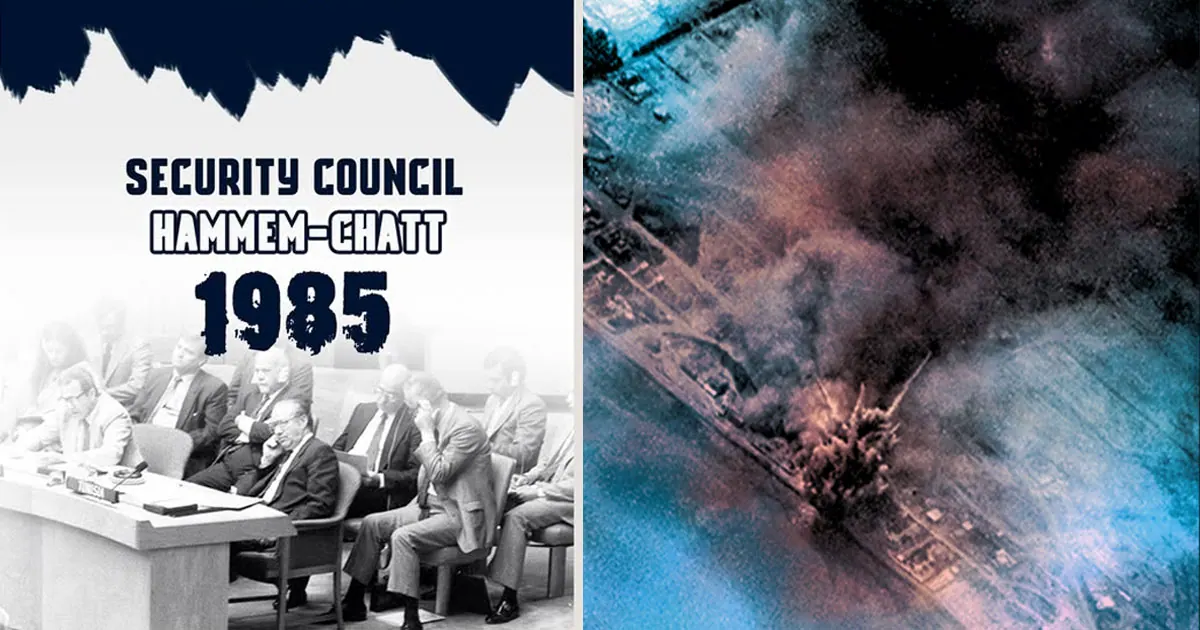
On October 4, 1985, the UN Security Council adopted Resolution 573, condemning Israel's aggression against the Palestine Liberation Organization (PLO) in Tunisia. The resolution was adopted with 14 votes in favor, no votes against, and one abstention from the United States. This resolution was significant as it was the first time the Security Council explicitly condemned Israeli aggression against Tunisian territory.
The aggression occurred when Israel attacked the PLO's headquarters in Hammam Chott, a suburb of Tunis, killing dozens of civilians, including Tunisians and Palestinians. The attack was in response to the assassination of three Israeli civilians on a yacht off the coast of Cyprus, claimed by the PLO's Force 17 unit.
The US initially supported Israel, with the White House describing the operation as a "legitimate act of self-defense." However, Tunisian President Habib Bourguiba and his European allies exerted pressure on the US administration to reconsider its stance. Bourguiba threatened to sever diplomatic ties with Washington if the US vetoed the resolution.
In the lead-up to the Security Council vote, intense negotiations took place. The Tunisian delegation, led by Foreign Minister Béji Caïd Essebsi, waited anxiously for the outcome. To gain time, the delegation asked Arab League Ambassador Clovis Maksoud to extend his speech, allowing the US to reconsider its position.
Maksoud's intervention was successful in delaying the vote, and the US eventually asked its representative to abstain, enabling the adoption of Resolution 573. The resolution was a significant victory for Tunisia and the PLO, and marked a turning point in international condemnation of Israeli aggression.
The event was witnessed by Noureddine Mezni, who was then Deputy Representative of the Organization of the Islamic Conference (OIC) to the UN. He recalled the scene where Israeli Ambassador Benjamin Netanyahu tore up the resolution document after its adoption, a gesture that reflected the tension surrounding the vote.
Forty-one years later, the event remains a significant moment in the history of the UN Security Council. Mezni's account provides a firsthand perspective on the diplomatic efforts that led to the adoption of Resolution 573, and the implications of the US abstention.
Key points
- The UN Security Council adopted Resolution 573, condemning Israel's aggression against the PLO in Tunisia, with 14 votes in favor and one abstention from the US.
- The resolution was a significant victory for Tunisia and the PLO, marking a turning point in international condemnation of Israeli aggression.
- The event highlighted the diplomatic efforts of Tunisian President Habib Bourguiba and his allies in pressuring the US to reconsider its initial support for Israel.