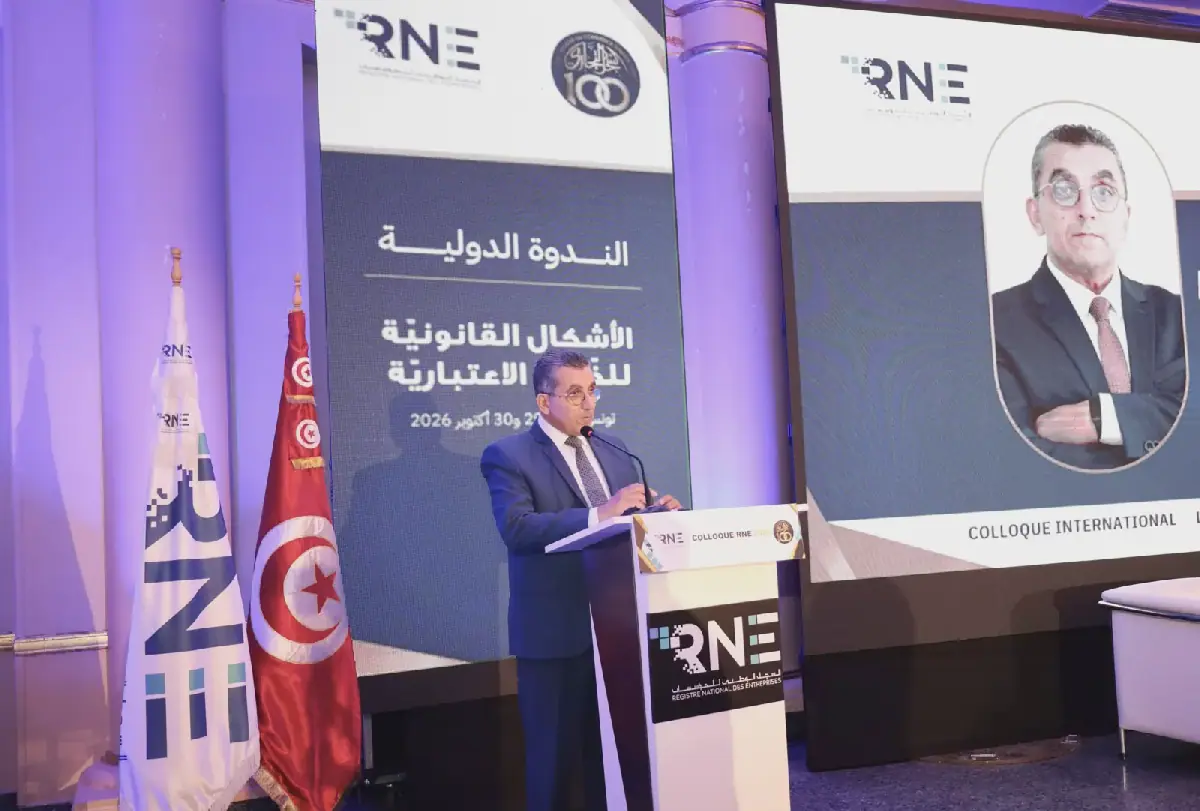
The Registre national des entreprises (RNE) in Tunisia recently held its third international scientific colloquium to commemorate the centenary of the country's commercial registry. The event, which took place on October 29-30, 2026, brought together jurists and experts to discuss the legal forms of moral persons. The theme of the colloquium was "Les formes juridiques des personnes morales," which translates to "The Legal Forms of Moral Persons." The discussions focused on the evolution of economic and legislative frameworks that require a rethinking of the status of moral persons.
The colloquium featured 13 interventions covering moral persons under private and public law, presented by academics from Tunisian universities, including Tunis El Manar, Sousse, and Sfax, as well as the Institut supérieur des études commerciales de Carthage. Experts from Canada, France, and Morocco also participated, sharing their experiences and allowing for a comparison of approaches, particularly in the Francophone world. The International Institute for the Unification of Private Law (UNIDROIT) was also represented.
Mohamed Adel Chouari, Director General of the RNE, explained that the theme was chosen due to the challenges encountered since the creation of the registry. Initially, the commercial registry only concerned commercial traders and companies. However, with the law on the RNE, registration now extends to all categories of persons, both physical and moral. This raises questions about the mandatory nature of registration for certain entities and the applicable legal regime.
Chouari also called on universities and scientific institutions present to conclude partnerships with the RNE to deepen the legal and practical aspects of its activity. He emphasized the importance of collaboration to address the complexities of the registry. The RNE has been playing a leading role in bringing together Francophone commercial registries, as acknowledged by Mayata Ndiaye Mbaye, Permanent Secretary of the Organization for the Harmonization of Business Law in Africa (OHADA).
Mbaye commended the RNE for its efforts in promoting cooperation among Francophone commercial registries. He recalled the 2022 Tunisian initiative that led to the creation of the Francophone Alliance of Commercial Registries, highlighting the benefits of this cooperation for the business climate and the reliability of economic information. The RNE has been instrumental in fostering this cooperation.
On the occasion of the colloquium, the RNE announced the publication of a documentary book on the history of the Tunisian commercial registry, from the creation of the first registry in 1926 to the establishment of the RNE in 2018. The book brings together archival documents and legal texts, tracing the major legislative and institutional milestones of this evolution.
The event demonstrated the RNE's commitment to promoting transparency, good governance, and legal security. The discussions and presentations highlighted the importance of adapting to changing economic and legislative frameworks to ensure the registry's effectiveness. The RNE's efforts to engage with academic and scientific institutions aim to strengthen its role in promoting a favorable business environment in Tunisia.
Key points
- The RNE's colloquium brought together experts from Tunisia and abroad to discuss the legal forms of moral persons.
- The event commemorated the centenary of Tunisia's commercial registry and highlighted the evolution of economic and legislative frameworks.
- The RNE announced the publication of a documentary book on the history of the Tunisian commercial registry.