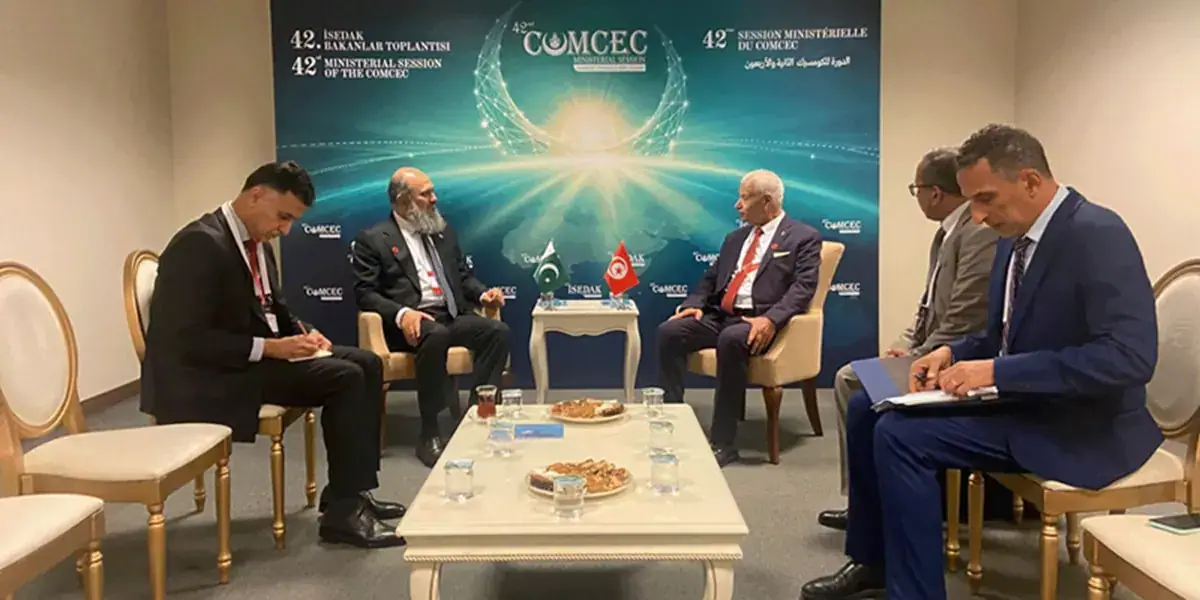
Tunisia and Pakistan are looking to strengthen their industrial cooperation in areas such as mining, textiles, and automotive components. The two countries' trade ministers, Samir Abid and Jam Kamal Khan, met in Istanbul on November 5, 2026, to discuss new partnerships. Their talks took place on the sidelines of the 42nd session of the COMCEC, a committee of the Organisation of Islamic Cooperation. The goal is to increase bilateral trade, which currently stands at a modest level.
The current trade volume between Tunisia and Pakistan is significantly lower than what the two countries' economies can support. In 2025, bilateral trade reached only $10.75 million, according to Pakistani data. This represents a decrease of 8.4% from 2024, when trade was worth $11.74 million. Pakistani exports to Tunisia totaled $8.55 million in 2025, mainly consisting of cotton, textile fibers, and animal products. In contrast, Tunisian exports to Pakistan were valued at $2.2 million.
The trade balance between the two countries favors Pakistan, with a surplus of around $6.35 million in 2025. Tunisian exports to Pakistan include textiles, electrical equipment, and oils and fats. Despite the current low trade volume, both countries see potential for growth in areas such as automotive components and mining. These sectors were identified as key areas for future cooperation during the Istanbul meeting.
During their discussions, Khan emphasized the complementarity of the technical skills and industrial capacities of the two countries. He mentioned the possibility of sharing know-how, improving production methods, and creating joint ventures to increase industrial competitiveness. Both ministers also stressed the need for better coordination between economic institutions and greater participation from the private sector.
The meeting in Istanbul follows bilateral political consultations held in Tunis in December 2025. On that occasion, the two countries examined ways to develop their commercial relations and investments. The latest talks reflect a shared desire to strengthen economic ties between Tunisia and Pakistan. The two countries are exploring ways to build on their existing trade relationships.
Key areas of cooperation include the exchange of expertise, technology transfer, and joint investment projects. Abid and Khan agreed to encourage their respective private sectors to engage in partnerships and joint ventures. This approach aims to increase trade and investment flows between the two countries.
The two countries are taking steps to enhance their economic cooperation. They are working to identify new opportunities for collaboration in various sectors. This effort is expected to lead to increased trade and investment between Tunisia and Pakistan.
Key points
- The two countries aim to increase bilateral trade, which currently stands at $10.75 million.
- The trade balance between the two countries favors Pakistan, with a surplus of around $6.35 million in 2025.
- Key areas of cooperation include mining, textiles, and automotive components.