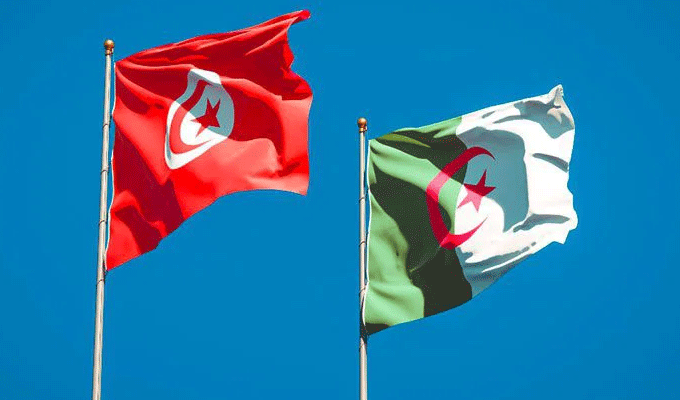
Trade between Tunisia and Algeria has seen a significant increase, reaching approximately $2.76 billion after a 166% growth over five years. According to data from the CEPEX, Algeria has become Tunisia's 7th largest global client and 4th largest supplier. The growth in trade has sparked ambitions to strengthen ties between the two countries, particularly in the automotive sector. This growth is a positive sign for both economies, which are looking to enhance their commercial relationship.
The composition of Tunisian exports to Algeria reveals a strong industrial presence. Mechanical and electrical industries account for 56.53% of Tunisian sales to Algeria, followed by diverse manufacturing industries at 31.53%, and agriculture and agri-food at 7.05%. This existing industrial base provides a solid foundation for further integration and cooperation between the two countries. The potential for growth and collaboration is substantial, with many opportunities for Tunisian and Algerian businesses to work together.
A recent economic mission organized in Algiers from September 22-24, 2026, has opened up new possibilities for cooperation in the automotive sector. The proposal aims to facilitate access to the Algerian market for Tunisian-produced automotive components and parts, and in return, provide access to the Tunisian market for assembled vehicles from Algeria. While this is still a proposal and not a concluded government agreement, it has significant industrial interest and could change the dynamics of the bilateral relationship.
The development of a joint automotive industry would require more than just commercial facilitation. It would necessitate compatible norms, predictable customs procedures, competitive logistics, and clear rules for accessing both markets. Discussions are underway to harmonize norms, develop logistics infrastructure, and establish border free zones. These are crucial steps towards creating a sustainable and integrated automotive industry.
According to the CEPEX, 43 Tunisian enterprises are active in Algeria, although this number refers to enterprises operating in the market, not necessarily industrial installations or subsidiaries. For the Tunisian economy, the goal is to capitalize on its base of suppliers and equipment manufacturers. For Algeria, the proposed opening could provide an additional outlet for its locally assembled automotive production.
The most ambitious scenario would be to consider the Tunisian-Algerian market as a springboard for exports to Africa, leveraging the Trans-Saharan Road. In this configuration, Tunisian industrial capacities, the Algerian market, and regional infrastructure could become complementary. However, this perspective remains a prospect, and the real test will come from transforming the proposals into operational mechanisms.
The challenge for Tunisia and Algeria is to determine if the growth in trade can be translated into sustainable productive integration, particularly in the automotive sector. With the right frameworks and agreements in place, the two countries can unlock the full potential of their economic relationship and create new opportunities for growth and development.
Key points
- The trade between Tunisia and Algeria has increased by 166% over five years, reaching approximately $2.76 billion.
- The two countries are exploring the possibility of a joint automotive industry, with a proposal to facilitate access to each other's markets for automotive components and assembled vehicles.
- The development of a joint automotive industry would require compatible norms, predictable customs procedures, and competitive logistics.