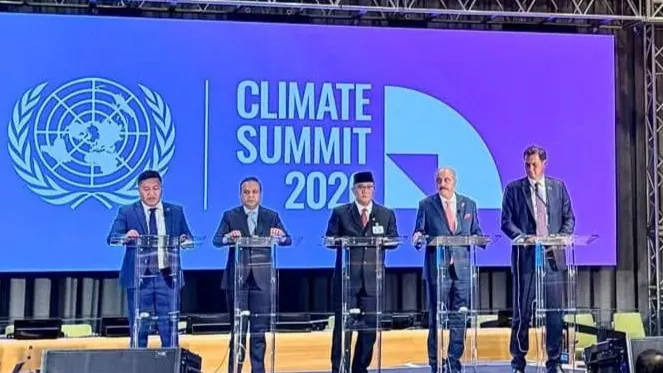
Tunisian Foreign Minister Mohamed Ali Nafti announced on September 24, 2026, in New York that Tunisia has raised its climate ambitions, targeting a 62% reduction in carbon intensity by 2035 compared to 2010 levels. This goal is part of the country's third nationally determined contribution (CDN 3.0). Nafti made the statement during a high-level event on climate action organized by the UN Secretary-General on the sidelines of the 81st session of the UN General Assembly.
The event focused on accelerating the transition to clean energy and enhancing resilience to climate change impacts. Nafti emphasized that Tunisia aims to increase the share of renewable energy in its electricity mix to 35% by 2030. He also noted that achieving the country's climate goals requires mobilizing approximately $55 billion in financing. This substantial investment is necessary to support Tunisia's efforts to reduce its carbon footprint and adapt to the challenges posed by climate change.
Nafti stressed that despite Tunisia's best efforts, national actions alone are insufficient to address the scale of the climate challenge. He called for greater access to concessional financing, grants, technology transfer, and capacity building for developing countries, particularly those most vulnerable to climate change. The minister also highlighted the importance of supporting investments in renewable energy and climate change adaptation, which can help developing countries meet their climate commitments.
Tunisia is working to enhance its national capacities for mobilizing climate finance. To this end, the country will organize a national workshop on October 7, 2026, in collaboration with the UN Development Programme. The workshop will focus on accessing multilateral climate finance and will bring together various national stakeholders and development partners. The event aims to explore practical ways to improve the mobilization of climate finance and direct it towards national priorities.
The workshop will provide a platform for stakeholders to discuss the challenges and opportunities related to climate finance in Tunisia. Participants will explore ways to enhance the country's access to climate finance and identify potential solutions to address the funding gap. By strengthening its capacity to mobilize climate finance, Tunisia can accelerate its transition to a low-carbon economy and enhance its resilience to climate change impacts.
Tunisia's climate ambitions are aligned with the goals of the Paris Agreement, which aims to limit global warming to well below 2°C and pursue efforts to limit it to 1.5°C above pre-industrial levels. The country's efforts to reduce its carbon intensity and increase its use of renewable energy can serve as a model for other developing countries. International cooperation and support will be crucial in helping Tunisia achieve its climate goals and address the challenges posed by climate change.
The international community has a critical role to play in supporting Tunisia's climate efforts. This includes providing access to concessional financing, technology transfer, and capacity building. By working together, countries can help Tunisia overcome the challenges associated with climate change and achieve its development goals. The country's commitment to reducing its carbon intensity and increasing its use of renewable energy is a positive step towards a more sustainable future.
Key points
- Tunisia aims to reduce its carbon intensity by 62% by 2035 and increase the share of renewable energy in its electricity mix to 35% by 2030.
- The country needs approximately $55 billion in financing to achieve its climate goals.
- Tunisia is working to enhance its national capacities for mobilizing climate finance and has announced a national workshop to explore practical ways to improve access to multilateral climate finance.