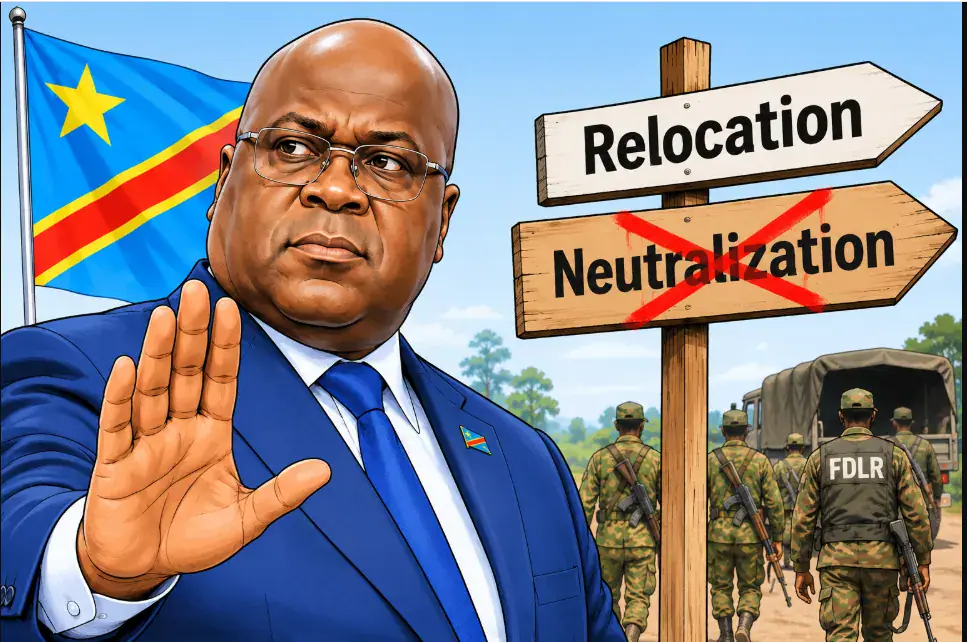
On October 30, President Félix Tshisekedi of the Democratic Republic of Congo (DRC) made comments that have sparked concerns about the country's commitment to demilitarizing the FDLR militia. During a meeting with Congolese citizens living in Russia, Tshisekedi stated that his government was considering relocating FDLR fighters to another country. This has raised questions about the DRC's commitment to implementing the Washington peace agreement, which calls for the disarmament and dismantling of the FDLR.
The FDLR militia has been a source of instability in the eastern DRC for years, and its disarmament is a key component of regional peace efforts. The Washington peace agreement, which was signed in 2015, aims to bring peace and stability to the region by disarming and reintegrating FDLR fighters. However, Tshisekedi's comments suggest that his government may be considering alternative solutions, such as relocating FDLR fighters to another country, rather than disarming and dismantling the militia.
The DRC's Minister of Foreign Affairs, Thérèse Kayikwamba Wagner, has since clarified that the country is not capable of disarming the FDLR due to the militia's presence in areas controlled by the M23 rebel group. However, this explanation has raised further questions about the DRC's commitment to implementing the Washington peace agreement. If the FDLR is too powerful for the DRC government to disarm, how can it be relocated to another country?
Tshisekedi's comments have also sparked concerns about the DRC's relationship with neighboring countries, particularly Rwanda. The FDLR militia has been accused of carrying out attacks on Rwandan territory, and Rwanda has long called for the DRC to take action to disarm the militia. Tshisekedi has previously accused Rwanda of using the FDLR as a pretext for its own security concerns in the region.
The international community, including the United States, has played a significant role in supporting peace efforts in the DRC. The US has provided significant funding and technical assistance to support the implementation of the Washington peace agreement. However, Tshisekedi's comments have raised concerns about the DRC's commitment to implementing the agreement and the potential consequences for regional stability.
The DRC government has faced criticism for its handling of the FDLR issue, with some accusing the government of lacking a clear strategy for disarming the militia. The government's inconsistent messaging on the issue has also raised concerns about its commitment to implementing the Washington peace agreement. If the DRC is unable or unwilling to disarm the FDLR, it is unclear what alternative solutions will be implemented to address the militia's activities.
The international community is waiting for clear explanations from the DRC government on its plans for the FDLR. The US, in particular, is seeking answers on the number of FDLR fighters that are currently being held, their location, and the plans for their disarmament and reintegration. The DRC government's ability to provide clear and consistent messaging on the issue will be crucial in determining the success of regional peace efforts.
Key points
- The DRC government's consideration of relocating FDLR fighters to another country has raised concerns about its commitment to implementing the Washington peace agreement.
- The FDLR militia has been a source of instability in the eastern DRC for years, and its disarmament is a key component of regional peace efforts.
- The international community, including the US, is seeking clear explanations from the DRC government on its plans for the FDLR.