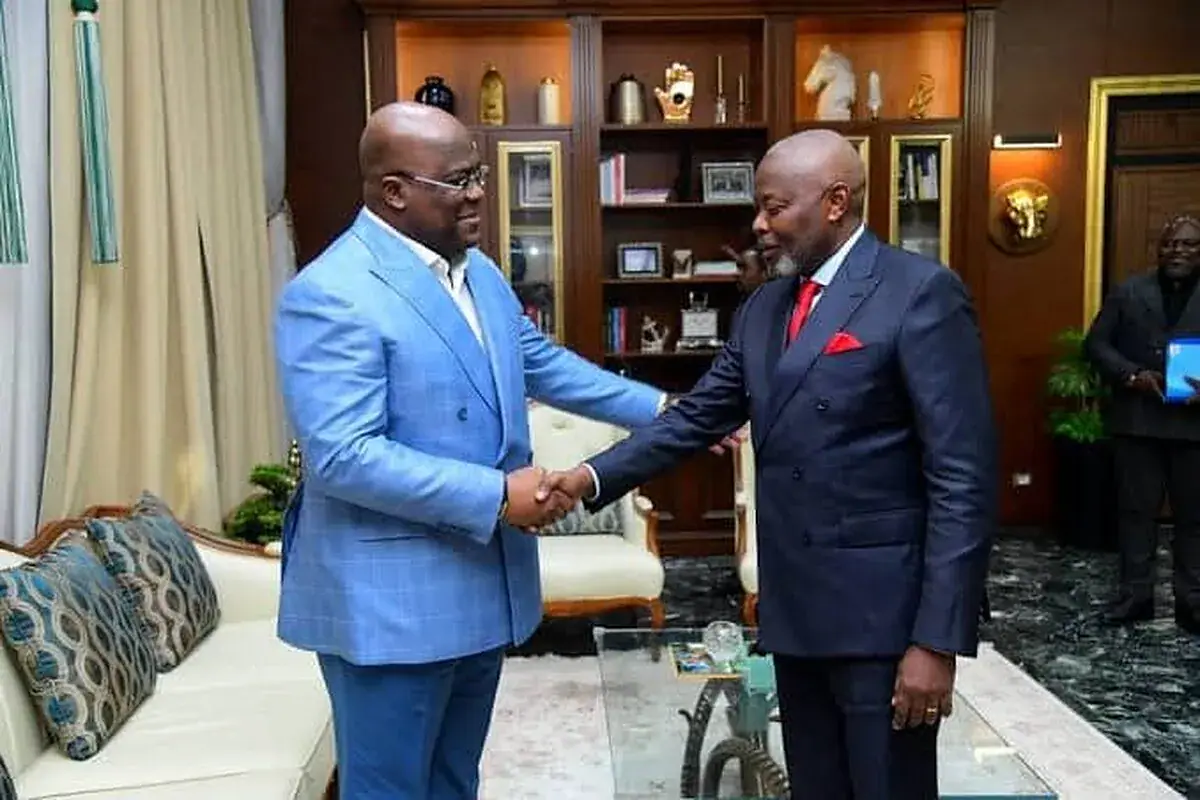
The political alliance between Felix Tshisekedi and Vital Kamerhe, which enabled Tshisekedi to become president, is experiencing difficulties. The partnership, formed in Nairobi in 2018, brought together Tshisekedi's Union for Democracy and Social Progress (UDPS) and Kamerhe's Union for the Congolese Nation (UNC). However, their relationship has deteriorated, with Kamerhe now facing growing distrust within the ruling coalition.
Kamerhe's recent statements on the conflict in eastern Democratic Republic of Congo and his advocacy for national dialogue have raised suspicions among some UDPS officials and presidential advisors. They question his intentions, with some speculating that he may be positioning himself for a future presidential bid. This has created tension within the coalition, with some viewing Kamerhe's actions as an attempt to challenge Tshisekedi's leadership.
The alliance between Tshisekedi and Kamerhe was initially seen as a strategic move to conquer and manage power. Kamerhe had renounced his own presidential ambitions to support Tshisekedi's candidacy in the 2018 election. In return, Kamerhe was given a key role in the presidential apparatus, including the presidency of the National Assembly in 2024. However, the current situation suggests that Kamerhe's influence may be waning.
The disagreements between Tshisekedi and Kamerhe also revolve around the issue of national dialogue and the management of the security crisis in eastern Democratic Republic of Congo. Some coalition members criticize Kamerhe for advocating for a political solution to the conflict, which they see as an attempt to pressure the government and Tshisekedi. This has led to a rift within the coalition, with some questioning Kamerhe's loyalty.
Billy Kambale, secretary-general of the UNC, has defended Kamerhe against accusations of "blackmail." Kambale's intervention aims to dispel the idea of a political rift between Kamerhe and Tshisekedi. However, the tensions between the two leaders remain, with some speculating that the alliance may not survive.
The situation is further complicated by the upcoming electoral cycle, which may exacerbate existing tensions within the coalition. The question of succession and the interpretation of the initial agreement between Tshisekedi and Kamerhe remain sensitive topics. It is unclear whether the alliance will be able to overcome its current challenges.
The fragility of the Tshisekedi-Kamerhe alliance has significant implications for the stability of the Democratic Republic of Congo. As the country navigates its complex politics, the relationship between these two key leaders will continue to be closely watched. The outcome may have far-reaching consequences for the country's future.
Key points
- The alliance between Felix Tshisekedi and Vital Kamerhe is facing significant challenges due to diverging views on the conflict in eastern Democratic Republic of Congo.
- Kamerhe's recent statements and actions have raised suspicions among some UDPS officials and presidential advisors, who question his intentions and loyalty.
- The situation has significant implications for the stability of the Democratic Republic of Congo, with the outcome potentially affecting the country's future.