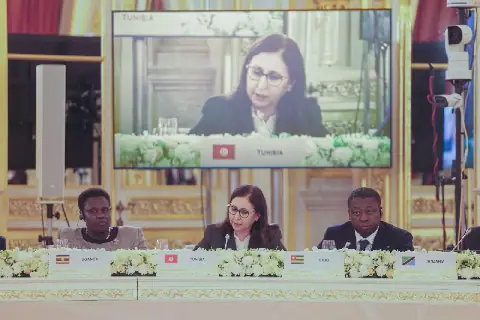
On October 27, 2026, Félix-Antoine Tshisekedi, President of the Democratic Republic of the Congo, participated in the third Russia-Africa Summit in Moscow. He emphasized the need for concrete results in cooperation between Russia and African countries. Tshisekedi expressed gratitude to Vladimir Putin for the invitation and warm welcome extended to the Congolese delegation. He stressed the importance of transforming diplomatic engagements into tangible achievements that improve the lives of citizens.
Tshisekedi reaffirmed the independence of the Congo's foreign policy, stating that diversifying international partnerships does not mean aligning with one power at the expense of another. Instead, it aims to preserve the country's freedom to make decisions in the best interest of its people. He advocated for a multipolar world that respects state sovereignty, territorial integrity, and the principles of the UN Charter. This stance reflects Kinshasa's desire to expand strategic partnerships while maintaining autonomy in diplomatic, economic, and security matters.
The security situation in eastern Congo was a significant focus of Tshisekedi's address. He highlighted the suffering of populations affected by armed violence and the illicit exploitation of natural resources, which fuels conflict and hinders development. The President reiterated his government's commitment to achieving durable peace through the restoration of state authority and protection of civilians. He mentioned diplomatic processes in Washington and Doha, in coordination with African mediation, and praised the efforts of the United States, Qatar, and African mediators.
Tshisekedi specifically called on Russia, as a permanent member of the UN Security Council, to support the full implementation of UN resolutions 2773 and 2808. These resolutions address the cessation of hostilities, withdrawal of the M23 from occupied areas, and the neutralization of the Democratic Forces for the Liberation of Rwanda (FDLR). He emphasized that Congo is fulfilling its obligations and expects the same level of commitment from all parties involved. By emphasizing these demands, Tshisekedi placed the issue of territorial sovereignty and respect for international commitments at the center of his diplomatic appeal.
Beyond security concerns, Tshisekedi outlined sectors where Congo seeks to deepen cooperation with Russia. These include access to energy, harnessing the country's hydroelectric potential, civil nuclear exploration, infrastructure development, local mineral processing, and food security. He advocated for economically viable projects that promote technology transfer, vocational training, and the participation of Congolese enterprises. Tshisekedi proposed that ministers identify a limited number of priority projects with identified financing, realistic timelines, and a regular monitoring mechanism.
Tshisekedi also addressed the reform of the UN Security Council, highlighting the need to correct historical injustices against Africa in international institutions. He referenced the Ezulwini Consensus and the Sirte Declaration, which reflect African demands for more equitable representation within the multilateral system. As a non-permanent member of the Security Council for 2026-2027, Congo aims to exercise its responsibilities with independence and promote balanced solutions to international crises.
Tshisekedi concluded by reaffirming Congo's readiness to deepen cooperation with Russia, based on mutual respect, reciprocity, and a focus on results. His intervention in Moscow underscores a dual ambition: to mobilize new partnerships to accelerate economic development and secure firmer diplomatic support for peace in eastern Congo. The challenge now is to translate political commitments into investments, economic opportunities, and measurable security progress.
Key points
- Tshisekedi urges Putin to support UN resolutions for peace in eastern Congo.
- Congo seeks deeper cooperation with Russia in energy, infrastructure, and mineral processing.
- Tshisekedi advocates for a multipolar world respecting state sovereignty and UN principles.