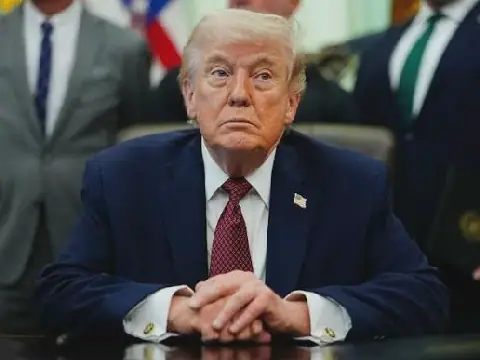
US President Donald Trump and Chinese leader Xi Jinping are holding a high-stakes meeting, with artificial intelligence (AI) at the top of the agenda. Trump has stated that the US is currently leading China in AI development, saying "whoever wins superintelligence wins... and we're leading now over China by a lot". The meeting has been billed as a crucial discussion, with the two leaders aiming to avoid an AI arms race.
The challenge of preventing an AI arms race has drawn comparisons to the nuclear proliferation talks between US President Ronald Reagan and Soviet leader Mikhail Gorbachev in the 1980s. Researchers Nicholas Wheeler and Marcus Holmes believe that, just as Reagan and Gorbachev developed a rapport that led to effective collaboration, Trump and Xi must reach a similar understanding to address the AI challenge. This understanding could foster cooperation and prevent an AI arms race.
The nature of power is becoming increasingly fluid in the 21st century, according to UN Secretary-General António Guterres. He noted that power is shifting not only geopolitically but also from nation-states to private corporations and from humans to machines. This shift will significantly influence key global challenges, including war, inequality, climate emergency, and artificial intelligence. Experts Stefan Wolff and Martin Waelisch caution that Trump's speech suggested a narrow focus on achieving victories, which may exacerbate rather than mitigate these problems.
The need for effective global governance has been highlighted, particularly in light of the UK taking the chair of the G20 in December. Former UK Prime Minister Gordon Brown pointed to the G20's successful response to the global financial crisis. However, Henrietta Moore, founder and director of the UCL Institute for Global Prosperity, argues that the current approach, which requires consensus among all member states, is flawed. She proposes a new framework, The New Alignment, which focuses on engaging key players that can make a difference in addressing global challenges.
The New Alignment framework, developed by Moore and her colleagues, calls for issues like climate change, sovereign debt, and technology to be tackled in a way that engages key players. This approach prioritizes problem-solving over consensus, allowing for progress even when agreement is not possible. By focusing on desired outcomes and identifying countries, institutions, businesses, and communities with the capabilities to deliver them, The New Alignment aims to facilitate effective global cooperation.
Recent election results in Russia and Germany have garnered significant attention. In Russia, President Vladimir Putin's party, United Russia, won a landslide victory in parliamentary elections. In Germany, the far-right Alternative für Deutschland (AfD) made significant gains in the state of Mecklenburg-Western Pomerania, winning 38.2% of the vote. The results have put pressure on German Chancellor Friedrich Merz, whose political survival is now uncertain. The rise of the far-right has been a concern in German politics, with mainstream parties operating a firewall to prevent extremist parties from gaining power.
Researchers have studied the ways in which supporters of extremist movements in Germany have circumvented bans on neo-Nazi symbols. By using coded language, such as wearing specific brands of clothes or displaying Nordic runes, these groups have found ways to self-identify and communicate online. This development highlights the ongoing challenge of addressing extremism in Germany and the need for effective strategies to counter its spread.
Key points
- The US and China are in a leading position in AI development, with Trump stating that the US is currently ahead of China.
- The meeting between Trump and Xi aims to prevent an AI arms race, with the two leaders seeking to develop a rapport and cooperate on AI issues.
- The nature of power is shifting in the 21st century, with implications for global challenges like AI, climate change, and inequality.