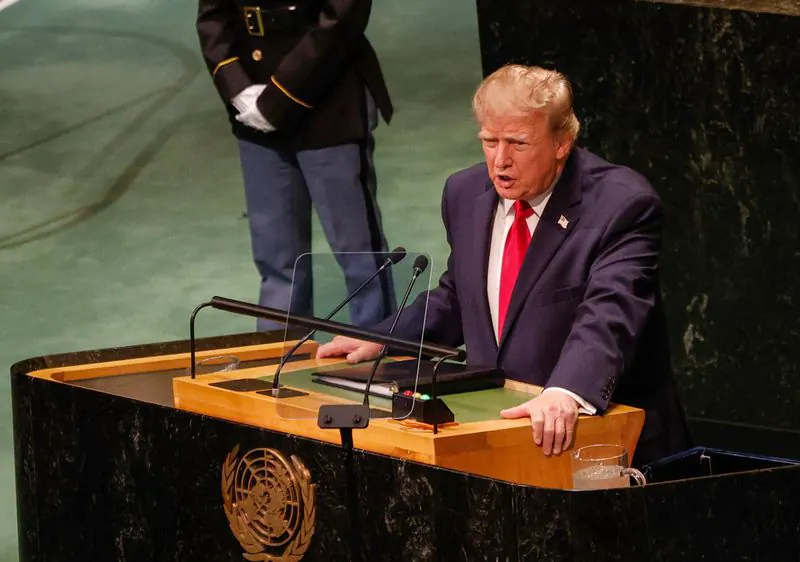
US President Donald Trump delivered a stern warning to Iran during his speech at the UN General Assembly in New York, stating that he could annihilate the Islamic Republic if no deal is reached. He emphasized that he has a significant decision to make regarding Iran, suggesting that an agreement could be imminent. Trump's comments came as diplomats engaged in discussions to end the nearly seven-month conflict between the US and Iran.
Iran's Armed Forces responded to Trump's comments, dismissing them as "propaganda" and stating that they are fully prepared to inflict severe and crushing blows on aggressors. The Iranian government's stance remains firm, with Parliament Speaker Mohammad Baqer Qalibaf asserting that Iran will never surrender to Trump's demands. This development occurs as US envoy Steve Witkoff reported that the US and Iran engaged in lengthy talks on the sidelines of the UN General Assembly.
The diplomatic efforts aim to address the conflict that began with joint US-Israeli strikes and has resulted in thousands of deaths, increased oil prices, and involvement from neighboring countries. Trump's meeting with Middle Eastern leaders focused on restoring shipping through the Strait of Hormuz, a critical conduit for global oil and gas shipments. The leaders expressed concerns about giving Iran too much power, while also hosting large US military bases that have faced repeated Iranian attacks.
Iranian foreign minister Abbas Araqchi met with Qatari Prime Minister Sheikh Mohammed bin Abdulrahman Al Thani, who has been working to de-escalate the conflict. A senior Iranian official revealed that Tehran could reopen the Strait of Hormuz within days if the US eased military pressure and lifted its blockade on Iranian ports. The Qatari state news agency reported that Araqchi and Al Thani discussed a potential agreement.
A Qatari proposal for a common security framework involving Iran and Arab Gulf states was discussed during the meeting with Trump. The proposal aims to provide security guarantees for Gulf states and expand economic interdependence with Iran. Saudi Arabia, which has been drawn deeper into the conflict, has faced advances by Iran-aligned Houthi fighters in Yemen, threatening Saudi oil exports through the Red Sea.
The US has faced pressure to rejoin the fight in Yemen, with Saudi Arabia's Crown Prince Mohammed bin Salman requesting US involvement. However, US Secretary of State Marco Rubio stated that the conflict is complex and that the US has a history with the Houthis. The US had reportedly considered striking the Houthis but ultimately decided against it. Oil markets found some relief after Saudi Arabia restarted operations at its East-West Pipeline.
The ongoing diplomatic efforts and potential agreements carry significant consequences for global oil markets, Gulf security, and the Iranian people. The conflict's outcome may also impact Trump's political standing ahead of the midterm elections. As discussions continue, the international community remains cautious, aware that the situation could escalate or improve in the coming weeks.
Key points
- Trump warns Iran could be annihilated if no deal is reached.
- Diplomatic efforts aim to address the conflict and restore shipping through the Strait of Hormuz.
- The conflict's outcome carries significant consequences for global oil markets, Gulf security, and the Iranian people.