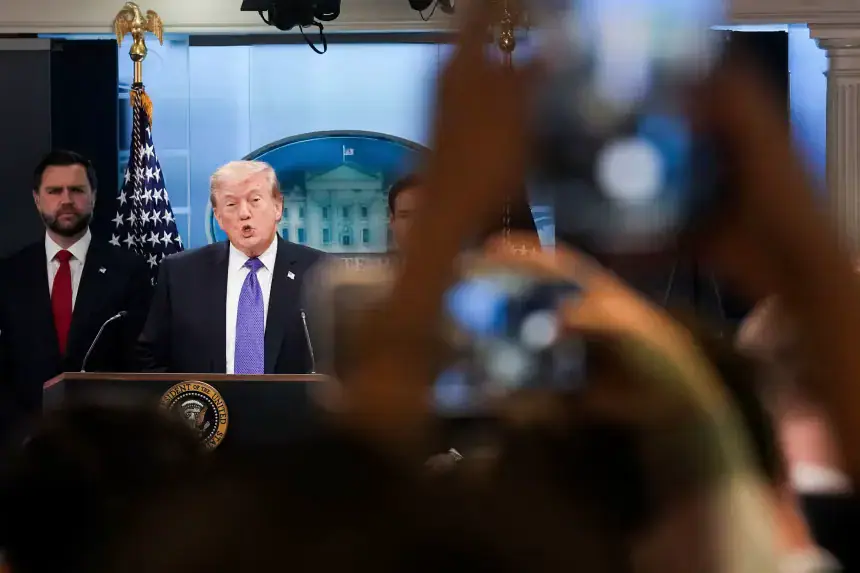
US President Donald Trump recently held a high-profile White House briefing room appearance, where he addressed various domestic challenges and his continued close personal friendships with Chinese leader Xi Jinping and Russia's Vladimir Putin. Trump emphasized the positive nature of these relationships, stating that he gets along well with leaders from various countries. He expressed his satisfaction with the warm reception he received in China and defended his description of Putin as "a friend."
During the 90-minute press conference, Trump lavished praise on Putin and Xi Jinping, despite concerns within his administration that Russia and China are working against US interests on key issues. Trump highlighted a historic trilateral summit, although it generated little substantive progress on thorny issues. However, when asked about pressing problems awaiting him at home, Trump had few detailed answers. The press conference showcased Trump's interactions with possible 2028 presidential contenders, including Vice President JD Vance and Secretary of State Marco Rubio.
Trump defended his friendship with Putin, citing their interactions during his first-term impeachment over withholding aid to Ukraine. He described Putin as "very nice" during that period. However, when asked if Putin is friendly to the US as a whole, Trump was less certain. The press conference also featured a discussion on the 2028 presidential election, with Vance and Rubio jockeying for Trump's favor. Rubio delivered an extended account of Trump's trip to Asia, focusing on benefits to the US economy and national security.
Trump made a new policy announcement during the press conference, vowing to crack down on US companies building data centers outside the country. He threatened to impose a "tremendous tax" on companies that choose to build data centers elsewhere, arguing that there is sufficient domestic demand for these structures powering the AI boom. However, it remains unclear what tax penalties companies would face if they don't comply, and Trump conceded that he hadn't briefed his team on the idea yet.
Trump openly acknowledged that the Iran war had soured Americans' mood and cost his party politically, but he showed no signs of backing off the conflict. He insisted that the war is necessary to prevent the Iranian regime from obtaining a nuclear weapon, stating, "Iran will never have a nuclear weapon, ever." Trump described Iran's leaders as "crazy" and expressed no regrets about prosecuting the war, despite apparent differences in opinion within his administration.
When asked about his strategy for winning the war and extracting the US from the Middle East, Trump had little to offer. The White House has yet to articulate a clear strategy, and Trump only stated that Iran was "bullsh*tting" him and that he was surprised the economic damage from the conflict hadn't been worse. Trump also discussed his approach to working with Democrats in the coming years, suggesting that he could either work as a bipartisan dealmaker or issue vetoes.
Trump concluded the press conference by expressing his willingness to work with Democrats, stating that the next two years could be productive if both parties are willing to collaborate. He emphasized that the choice of approach would depend on the Democrats, saying that he could either veto their proposals or work with them to achieve common goals.
Key points
- Trump defended his close relationships with Putin and Xi Jinping during a White House press conference.
- Trump hinted at a possible presidential run by his chief of staff, Stephen Miller.
- Trump announced plans to crack down on US companies building data centers outside the country.