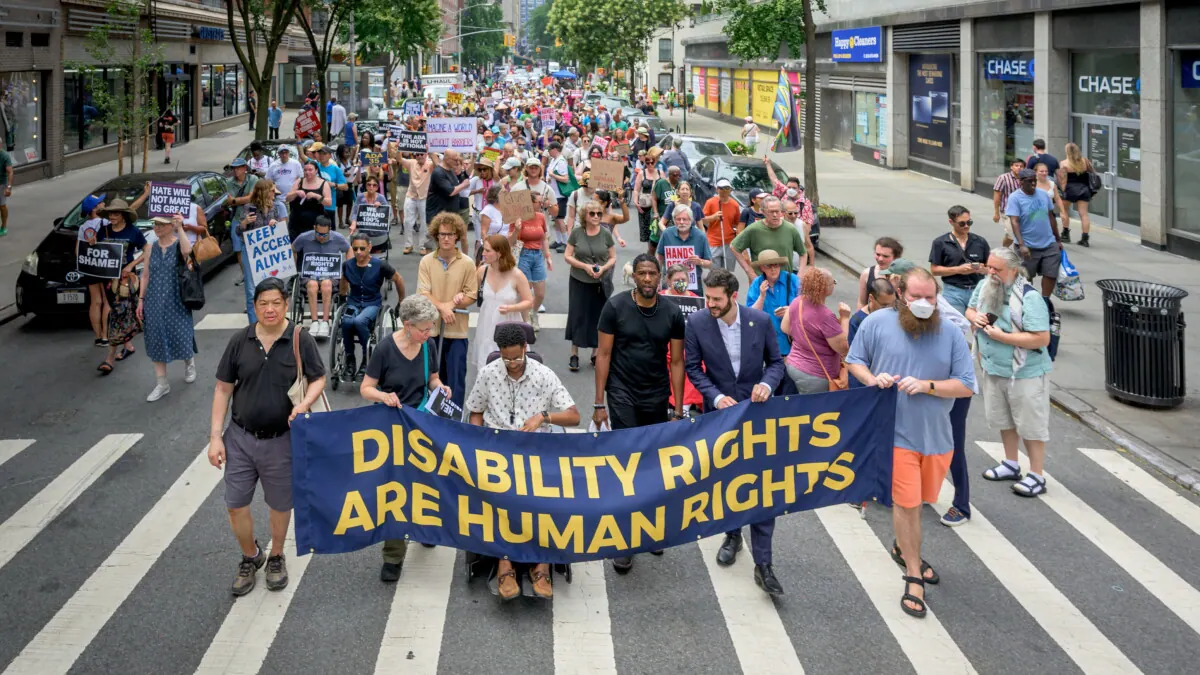
The Trump administration has taken a significant step in reversing a decades-long stance on integrating people with disabilities into society. A federal judge has agreed to remove mentions of "integration" from federal regulations tied to Section 504 of the Rehabilitation Act, a landmark civil rights law that prohibits disability discrimination. This move is a departure from nearly 50 years of federal policy that encouraged people with disabilities to live, work, and learn in the most integrated setting possible.
The change in stance has sparked concern among disability rights advocates, who argue that it will impact people's rights and the way states behave. The court's decision removes regulations that explicitly required federally funded programs to provide services in the "most integrated setting." Disability rights lawyer Jennifer Mathis notes that while the decision did not undo integration protections tied to the Americans with Disabilities Act (ADA) or those established by decades of case law, it will likely have a significant impact on the rights of people with disabilities.
The Trump administration's reversal of its stance on integration has been met with criticism from disability rights advocates, who argue that it is a step backward for people with disabilities. Bruce Darling, president and CEO of the Center for Disability Rights, says that the decision feels like a "knife in your chest" and that it sends a message that people with disabilities do not have a right to live in freedom. His organization is working on a proposed law that would cement protections around integration.
The federal government's change in stance on integration is a significant departure from its longstanding position. In 1973, Congress passed the first civil rights law for people with disabilities, Section 504 of the Rehabilitation Act. It took advocates years of fighting to get actual regulations that would make that law enforceable. The Department of Health and Human Services updated the regulations in 2024 to make it clearer to states what they had to do to uphold the law.
In recent months, the federal government has publicly changed its position on integration. In June, the Justice Department issued an opinion saying it no longer interpreted disability law to require states to treat mentally disabled patients in the most integrated setting appropriate to their needs. The memo noted that its position was "out of step" with the common understanding of the Olmstead decision. This change in stance has led to concerns that states will be freer to cut spending on programs for community-based living.
The impact of the federal government's changing position on integration is already being felt. In Florida, a case involving children with complex medical needs has been affected by the government's new stance. The Justice Department had previously won a case against the state of Florida, arguing that it failed to provide adequate services to children who needed in-home care. However, in August, the government told the federal court to throw out its victory and allow Florida to have the case heard again in district court.
Disability rights advocates are rallying around a number of actions to try to combat the federal government's latest actions. Alison Barkoff, a health law and policy professor at George Washington University, says that the disability community is hard at work trying to protect the rights of people with disabilities. Some members of Congress have reaffirmed their commitment to the rights of people with disabilities to get the services they need to live in their communities.
Key points
- The Trump administration's reversal of its stance on integration has sparked concern among disability rights advocates.
- The change in stance has been met with criticism from disability rights advocates, who argue that it is a step backward for people with disabilities.
- Disability rights advocates are working to protect the rights of people with disabilities and ensure that they have access to community-based services.