Transport operators in Ghana have issued a seven-day ultimatum to the government to engage with them over the implementation of the TraffiTech system. The operators, represented by the Transport Operators of Ghana, expressed concerns over the system's current form and threatened a nationwide demonstration and withdrawal of their vehicles from service if their demands are not met. They also warned of potential political consequences for the government in the 2028 general elections.
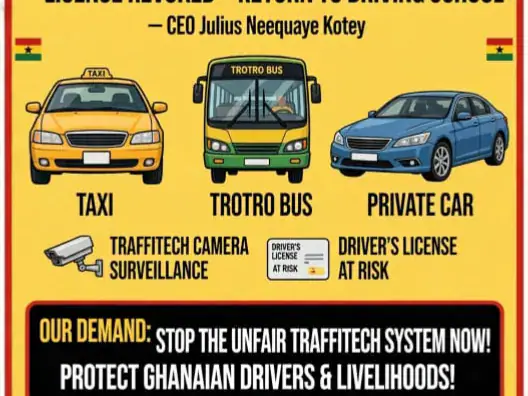
The operators' concerns center on a proposed sanction attributed to the Chief Executive Officer of the Driver and Vehicle Licensing Authority (DVLA), Julius Neequaye Kotey. According to the sanction, drivers who commit six TraffiTech violations within two years could have their licences revoked and be required to return to driving school. The operators described this penalty as harsh and unfair, arguing it could deprive drivers of their livelihoods and worsen financial difficulties facing families dependent on commercial transport.
The operators questioned the fairness of imposing severe penalties when some roads lack adequate speed-limit signs and traffic lights remain faulty. They also argued that motorists allegedly receive incorrect fines from TraffiTech cameras. Furthermore, the group claimed that drivers have not received sufficient education on the system to justify the introduction of severe penalties. They are demanding the immediate suspension of the proposed licence revocation measure and a review of the fines imposed under TraffiTech.
In addition to the suspension of the licence revocation measure, the operators are calling for a one-year education and warning period to allow drivers to understand the system before punitive measures are fully enforced. They also want the government to repair faulty traffic lights, improve road signage, and review the TraffiTech contract, which they claim places an unfair financial burden on drivers and vehicle owners.
The operators maintained that they are not opposed to measures aimed at improving road safety but are concerned that the system, in its current form, could become a revenue-generating mechanism at the expense of motorists. They warned that failure to address their demands could trigger nationwide protests and disrupt transportation services across the country. The group also threatened to campaign against the government in the 2028 general elections if the implementation of TraffiTech continues without changes.
The statement was issued by Transport Operators of Ghana and signed by Akwasi Amoah, National Chairman of the Drivers and Car Owners Association, and the National Chairman of the Transport and Drivers Welfare Union of Ghana. At the time of the statement, the government and relevant authorities had not responded to the demands. The operators emphasized the need for meaningful engagement with stakeholders to ensure that road safety enforcement measures are fair, transparent, and responsive to the challenges facing drivers.
The Transport Operators of Ghana stressed that while road safety remains important, enforcement measures must be accompanied by adequate public education, functional road infrastructure, and penalties that are proportionate to the offences committed. They called on the government and relevant regulatory institutions to initiate dialogue within seven days to prevent an escalation of their concerns. The government and relevant authorities have yet to respond to the ultimatum.
Key points
- Transport operators in Ghana have given the government a seven-day ultimatum to address concerns over the TraffiTech system implementation.
- The operators are demanding the suspension of a proposed licence revocation measure and a review of fines imposed under TraffiTech.
- Failure to address their demands could trigger nationwide protests and disrupt transportation services across the country.