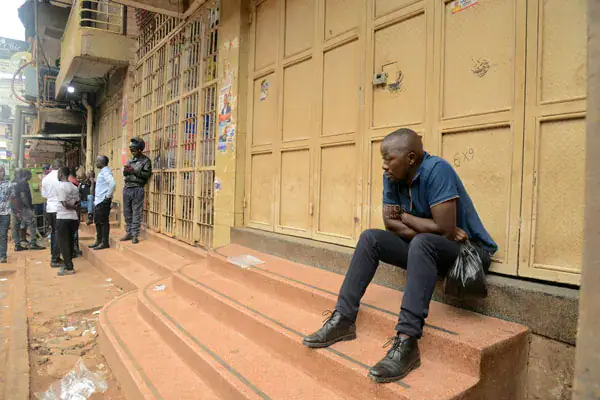
A section of traders in downtown Kampala have closed their shops due to the heavy tax burden they face. According to the traders, it is not just one tax that is causing them distress, but the numerous taxes they are required to pay. These taxes are imposed by various offices, often repeatedly, leaving business owners with very little to keep. The taxes include a trading licence, Local Service Tax, Uganda Registration Services Bureau (URSB) fees, National Social Security Fund (NSSF) contributions, and income tax.
The tax burden on traders in Uganda is substantial. A Grade I retailer in Kampala pays Shs210,000 for a trading licence, while a Grade IV retailer pays Shs31,500. A supermarket pays up to Shs1,125,000. In addition to the trading licence, traders also pay Local Service Tax ranging from Shs5,000 to Shs100,000 a year. They also pay URSB fees of Shs35,000 for a business name and Shs50,000 for a company.
Traders in Uganda also contribute to the National Social Security Fund (NSSF), which is 15 percent of gross monthly wages. This is made up of 10 percent from the employer and five percent deducted from the employee. Furthermore, traders pay income tax, which is 30 percent of chargeable income if they are a company, or presumptive tax up to Shs150 million turnover if they are a small business. Above that, they enter the normal income tax system.
The introduction of the Electronic Fiscal Receipting and Invoicing Solution (EFRIS) has also added to the burden of traders. They are required to use EFRIS and issue e-invoices or e-receipts. Without them, six percent withholding Value Added Tax (VAT) is charged. All these taxes and fees add up to a significant amount. A trader with a turnover of Shs200 million a year and a profit of Shs24 million, employing two workers, pays about Shs8.3 million a year in taxes before buying stock, paying rent, or paying school fees.
According to Mr Robert Kalumba, the assistant commissioner/manager for public and corporate affairs at the Uganda Revenue Authority (URA), the government is considering reducing the tax rate on imported apparel. The proposed reduction is from the current levels to about $1 (about Shs4,000) per kilogramme, from the existing $2.50 (about Shs10,000) to $3.50 (about Shs15,000) per kilogramme, or 35 percent of the Cost, Insurance and Freight (CIF) value, whichever is higher.
The standoff between the traders and the government is being resolved. After the last meeting between the traders, government officials, and URA officials, Prime Minister Robinah Nabbanja informed Parliament that she would present the matter to Cabinet for a final verdict. The presentation was expected yesterday. The government is trying to find a solution to the traders' concerns, which include the high tax burden.
The high tax burden on traders in Uganda has significant implications for the economy. It can lead to reduced profits, closure of businesses, and loss of employment opportunities. The government needs to strike a balance between collecting revenue and creating a conducive business environment. The proposed reduction in tax rates on imported apparel is a step in the right direction. However, more needs to be done to address the concerns of traders and promote economic growth.
Key points
- The tax burden on traders in Uganda is substantial, with multiple taxes imposed by various offices.
- The government is considering reducing the tax rate on imported apparel to alleviate the burden on traders.
- The high tax burden on traders in Uganda has significant implications for the economy, including reduced profits and loss of employment opportunities.
Reporting sources
- Behind closed shops: A deep dive into traders’ tax burden · Daily Monitor