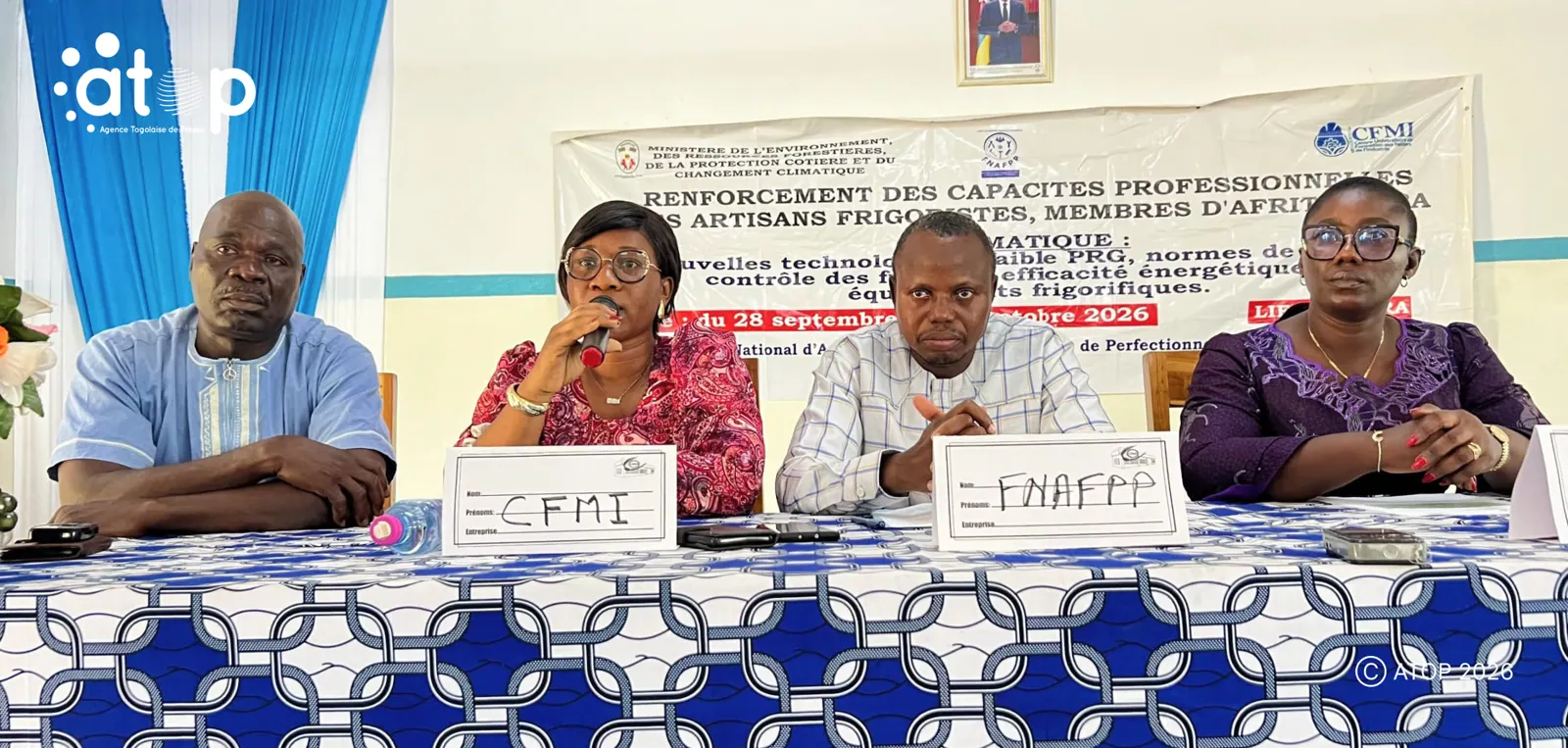
In a bid to enhance the skills of refrigeration technicians in Togo, 25 artisans from the Association des frigoristes du Togo (AFRITO), section Kara, have begun a five-day training on low-Potentiel de réchauffement global (PRG) technologies. The training, which started on September 28 and will end on October 2, is being organized by the Centre de formation aux métiers de l’industrie (CFMI) in collaboration with the Bureau national ozone (BNO) of the Ministry of Environment.
The training aims to adapt the skills of refrigeration professionals to evolving technologies and environmental requirements. It is being financially supported by the Fonds national d’apprentissage, de formation et de perfectionnement professionnels (FNAFPP). The program focuses on improving the quality and safety of interventions by technicians on refrigeration and air conditioning equipment. Participants will be trained on PRG concepts, related issues, and low-GWP refrigerants.
The training will cover essential topics such as safety rules, risks associated with refrigeration installations, leak detection, and circuit leak-tightness control. Technicians will also learn about using leak detection tools, identifying causes of reduced energy performance, and best practices for equipment maintenance and energy consumption optimization. This comprehensive training is expected to enhance the expertise of refrigeration technicians in Togo.
The importance of the refrigeration and air conditioning sector in preserving food and supporting the cold chain in healthcare and thermal comfort was emphasized by Lochina Moussa Mohamadou, head of the FNAPP office in Kara. He encouraged participants to be attentive and committed to improving their professional practices during the training.
Mme Assimti-Tchao Bidénam, coordinator of the BNO, stated that this activity aligns with Togo's commitments under the Vienna Convention and the Montreal Protocol on substances that deplete the ozone layer. She explained that certain substances used in refrigeration equipment can contribute to ozone layer depletion and climate change when released into the atmosphere.
Mme Assimti-Tchao Bidénam also stressed the need to manage risks associated with alternative refrigerants, such as hydrocarbons, while promoting a transition to low-GWP refrigerants. The training is a significant step towards mitigating the environmental impact of refrigeration technologies in Togo.
The training was officially opened with participation from Mme Yesso Olou-Adara, a training advisor at CFMI. With this initiative, Togolese refrigeration technicians are expected to enhance their skills and contribute to environmentally friendly practices in the sector.
Key points
- The training aims to adapt the skills of refrigeration professionals to evolving technologies and environmental requirements.
- The program focuses on improving the quality and safety of interventions by technicians on refrigeration and air conditioning equipment.
- The training aligns with Togo's commitments under the Vienna Convention and the Montreal Protocol on substances that deplete the ozone layer.