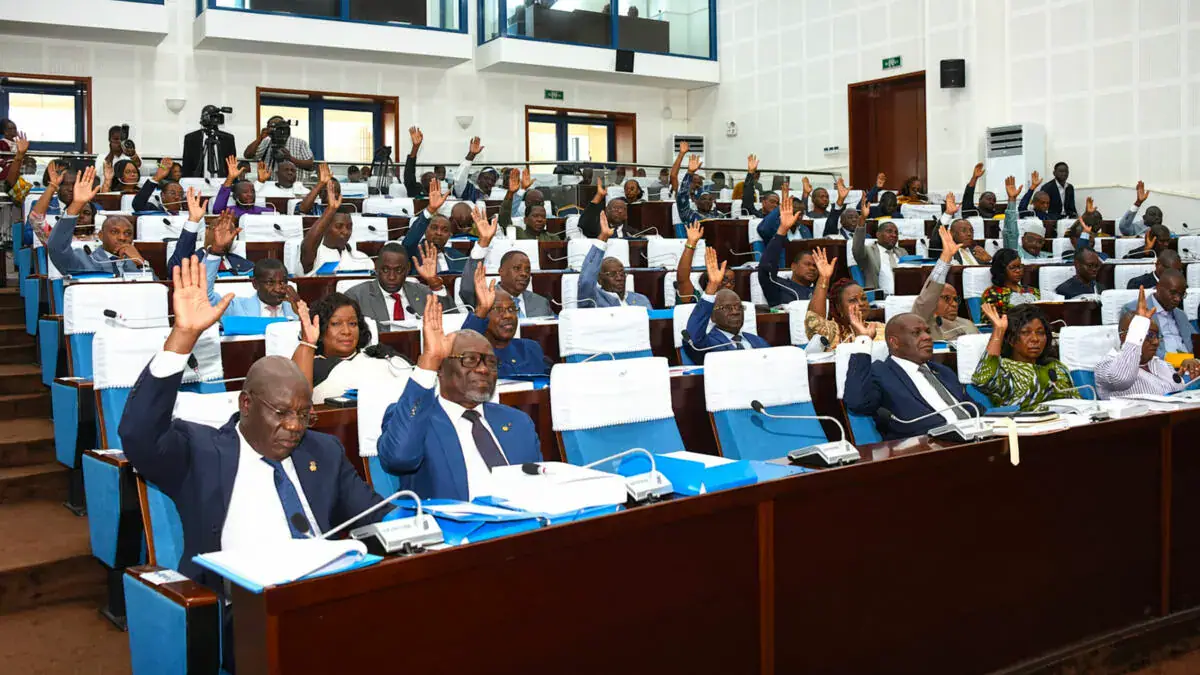
The Togolese National Assembly adopted on Thursday, November 27, 2026, in first reading, the 2026 supplementary budget and the 2027 finance bill. Finance and Budget Minister Essowé Georges Barcola praised the parliamentary dialogue as "exigent and constructive". The adoption comes as the global economy faces challenges, including the war in the Middle East and the closure of the Strait of Hormuz, which are expected to drive oil prices up by around 32% and slow global growth to 3%.
Despite these challenges, Togo's economy remains on track, with growth projected at 6.3% in 2026, only 0.2 points less than initially forecast, and 6.5% in 2027. The 2026 revised budget stands at 2,744.2 billion Fcfa, slightly down from the initial 2,751.5 billion. It includes three adjustments: an additional 20 billion Fcfa subsidy on petroleum products to protect purchasing power, a redeployment of 11 billion Fcfa in current expenditure without a global increase, and 96.4 billion Fcfa in additional borrowing for projects, mainly agricultural mechanization and digital development.
The adjustments have resulted in a slight increase in the deficit, which now stands at 3.4% of GDP, up from 3%. Minister Barcola attributed this increase solely to the international crisis. The 2027 budget, which balances at 2,684.1 billion Fcfa, represents a 2.5% decrease. This decrease is largely due to a reduction in debt repayment, down by 161 billion Fcfa. Budget revenues are expected to increase by 3.7%, to 1,615.2 billion Fcfa, while expenditures will rise by 5.1%, to 1,915 billion Fcfa.
A key highlight of the 2027 budget is the reduction of the deficit to 3% of GDP, in line with the West African Economic and Monetary Union (UEMOA) norms. The budget allocates 855.2 billion Fcfa to the 15 programs outlined in the 2026-2031 roadmap. To finance these ambitions, the government is counting on broadening the tax base and strengthening the fight against fraud. It also reconfirms 14 tax measures, including the exemption of VAT on local livestock and fishing products and the tax credit for the recruitment of people with disabilities.
Minister Barcola emphasized that the government will adhere to the "golden rule" of a 3% deficit. He concluded by reiterating a directive from the President of the Council, Faure Essozimna Gnassingbé, that every franc inscribed in the budget must produce "visible, measurable, and directly perceptible" results for Togolese citizens. This approach aims to ensure greater accountability and effectiveness in budget execution.
The global economic environment remains challenging, with oil-importing countries like Togo facing significant headwinds. The government, however, appears determined to navigate these difficulties while maintaining a growth trajectory. The implementation of the 2026-2031 roadmap and the budgetary measures adopted will be closely watched to assess their impact on the Togolese economy and population.
As the Togolese government moves forward with its economic plans, it faces the task of balancing budgetary discipline with the need to stimulate growth and improve living standards. The commitment to maintaining a deficit of 3% of GDP, as per UEMOA norms, underscores the government's resolve to ensure macroeconomic stability. The success of these efforts will depend on effective implementation and the ability to adapt to evolving global and domestic conditions.
Key points
- The Togolese National Assembly adopted the 2026 supplementary budget and the 2027 finance bill, aiming to balance budgetary discipline with growth stimulation.
Reporting sources
- Collectif budgétaire et budget 2027 · republicoftogo.com