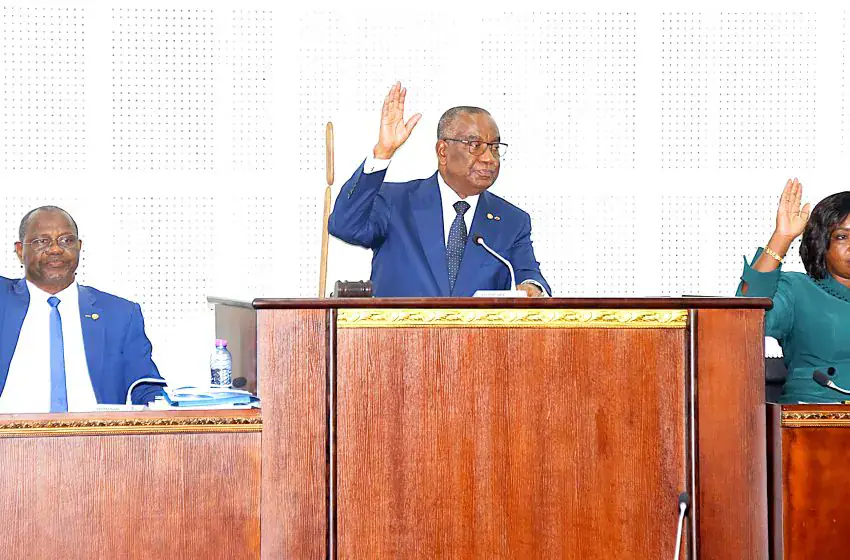
The Togolese National Assembly held its sixth plenary session of the second ordinary session of 2026 on November 26, 2026, at its headquarters in Lomé. The session was chaired by the President of the National Assembly, Komi Selom Klassou, and attended by several ministers, including Essowè Georges Barcola, Badanam Patoki, and Gilbert Bawara, as well as Yawa Djigbodi Tsègan, Commissioner General of the Office of Revenue Collection.
The National Assembly adopted in first reading the draft 2027 finance bill and the 2026 supplementary budget. The 2027 budget is set at 2,684.1 billion CFA francs in resources and charges, down 67.5 billion CFA francs or 2.5% from 2026. The 2026 supplementary budget aims to adapt the state budget to a degraded international context and reorient internal resources to address the effects of the oil shock on populations.
The 2026 supplementary budget shows a recomposition of resources, with a 39 billion CFA franc decrease in project grants offset by a 96 billion CFA franc increase in project loans. The budget also aims to preserve investment and purchasing power, with a focus on rationalizing expenditures and reducing the use of the regional financial market.
The 2027 budget prioritizes the implementation of the new government roadmap for 2026-2031, focusing on consolidating public finances and reducing the deficit to 3% of GDP. The budget maintains a growth rate of 6.3% in 2026 and 6.5% in 2027, driven by the primary, secondary, and tertiary sectors.
The 2027 budget reconducts 14 fiscal and customs incentives introduced in recent years, including exemptions for purchasing new vehicles, electric vehicles, and agricultural equipment. The budget also provides for a substantial allocation to investment projects, with 490 billion CFA francs dedicated to this purpose.
The 2027 budget allocates 855 billion CFA francs to implement the government's roadmap, with priorities focused on protecting, gathering, and transforming. The budget also aims to expand the tax base, combat tax evasion, and simplify procedures for entrepreneurs.
Following the debates, President Komi Selom Klassou stated that the National Assembly had exercised one of its highest prerogatives by authorizing and controlling the use of public funds. The adopted budgets reflect the government's efforts to manage the country's finances effectively and promote economic growth.
Key points
- The 2027 budget is set at 2,684.1 billion CFA francs, down 2.5% from 2026.
- The budgets prioritize preserving investment and purchasing power, as well as implementing the government's roadmap for 2026-2031.
- The National Assembly exercised its prerogative to authorize and control the use of public funds by adopting the budgets.