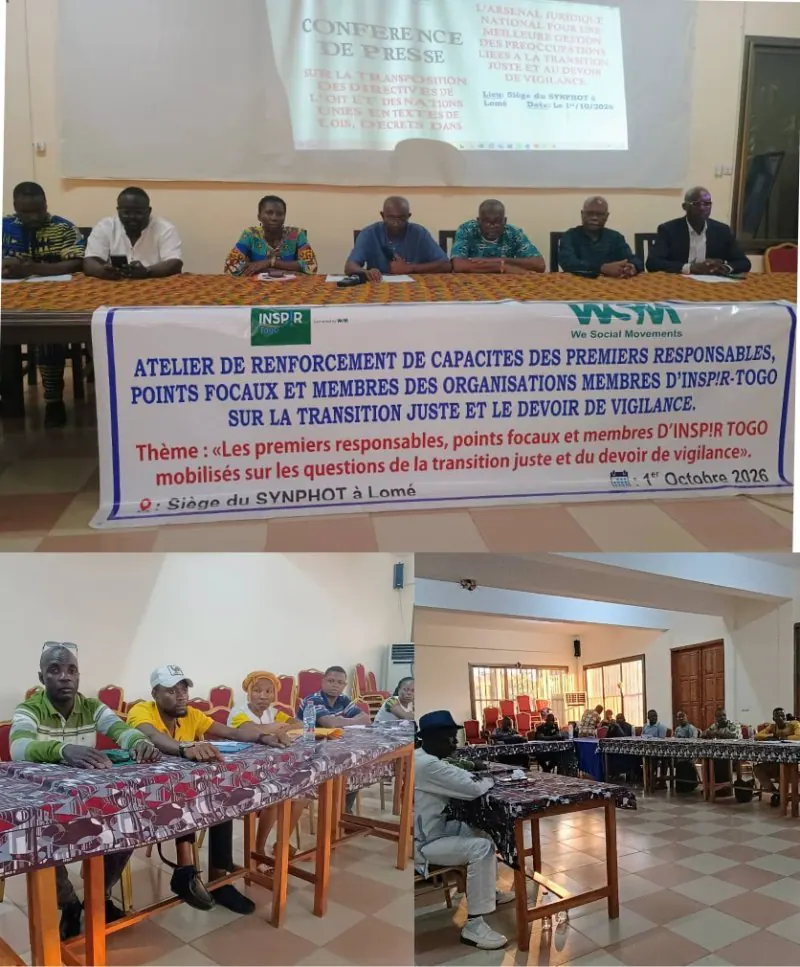
On October 1, 2026, INSP !R-Togo, a network of organizations in Togo, held a press conference in Lomé to discuss the importance of integrating the principles of just transition and vigilance duty into the country's laws. The network, comprising 14 organizations from various sectors, including trade unions, civil society, and human rights groups, aims to ensure that Togo's transition to a greener economy does not compromise the rights of workers and communities.
INSP !R-Togo's point focal, Niwa SOULIMA, emphasized that the global shift towards a green economy must prioritize the preservation of workers' rights and community well-being throughout the production chain. The organization is advocating for the incorporation of international labor and UN standards into national laws, regulations, and decrees to strengthen obligations on companies, particularly multinationals, to protect workers, populations, and the environment.
While acknowledging progress made by the Togolese authorities, such as the 2008 environmental framework law and the 2025 climate law, INSP !R-Togo notes that challenges persist. SOULIMA highlighted that workers are not adequately represented in discussions on the social and professional implications of ecological transition, calling for greater participation in tripartite and bipartite dialogues.
The network's declaration emphasizes the need for a stronger legal framework to ensure companies respect human rights, social norms, and environmental standards throughout their supply chains. INSP !R-Togo specifically highlights the precarious working conditions and life circumstances of certain workers, the rise in workplace accidents, and the emergence of new occupational diseases.
INSP !R-Togo is focusing on the mining, construction, healthcare, and domestic work sectors, which often lack sector-specific collective agreements. The organization is urging the government to accelerate the development of such agreements and strengthen social dialogue mechanisms, including the establishment of a conciliation committee for domestic workers.
The network has made several requests to the government, including the development of a law on corporate vigilance duty, taking into account international agreements ratified by Togo. INSP !R-Togo also advocates for support for the ratification of certain ILO conventions and the adoption of a national occupational safety and health policy.
Ultimately, INSP !R-Togo seeks to ensure that Togo's ecological transition is socially inclusive, prioritizing human rights, social protection, and decent working conditions. The organization hopes that the government will consider its recommendations, leading to improved working conditions, reduced accidents, and enhanced social dialogue.
Key points
- INSP !R-Togo urges Togo to integrate just transition and vigilance duty principles into national laws
- The organization advocates for stronger obligations on companies to protect workers, populations, and the environment
- INSP !R-Togo requests the government to develop a law on corporate vigilance duty and support the ratification of certain ILO conventions