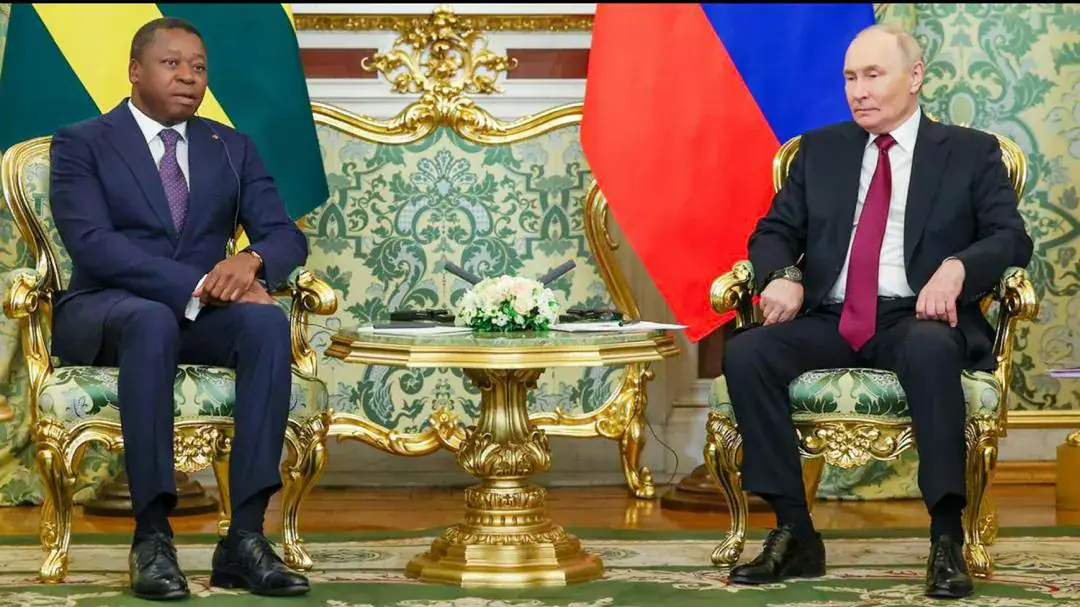
The third edition of the Russia-Africa Summit will take place in Moscow, Russia, on October 28-29, 2026. The summit is a diplomatic and economic meeting aimed at deepening relations between Russia and African states. Togo's President, Faure Essozimna Gnassingbé, will attend the summit, as confirmed by Russian Ambassador to Togo, Igor Evdokimov. This attendance is part of Lomé and Moscow's efforts to translate their diplomatic rapprochement into structured economic partnerships.
The summit is set against the backdrop of a changing international environment characterized by diversifying economic alliances, strategic rivalries, and the search for new diplomatic balances. The program includes an economic and humanitarian forum, meetings between politicians and economic operators, and sectoral discussions on trade, investments, energy, agriculture, digital technologies, artificial intelligence, and security. The plenary session on October 29 will be co-chaired by Russian President Vladimir Putin and Burundian President Évariste Ndayishimiye, the current African Union chairman.
A new plan of action for 2027-2029 is expected to be adopted to guide the next steps of the Russia-Africa partnership. This summit takes place in a sensitive geopolitical context, marked by the ongoing war in Ukraine, international sanctions against Russia, and questions about the financing and execution of international projects. African countries aim to leverage cooperation offers without compromising their economic interests, international commitments, or ability to maintain constructive relations with all partners.
President Faure Gnassingbé's attendance follows the recent first session of the Togo-Russia Intergovernmental Mixed Commission, held in Lomé from September 29 to October 1, 2026. The commission reviewed cooperation possibilities in trade, energy, industry, agriculture, transport, mining, education, science, and technology. Two memoranda of understanding were signed, with other agreements and projects in preparation. Discussions included developing commercial corridors, logistics infrastructure, and energy cooperation.
The summit in Moscow may provide President Gnassingbé with an opportunity to pursue high-level discussions with Russian authorities, clarify the implementation timeline of envisaged projects, identify financing mechanisms, and seek new commitments from Russian companies and institutions. The participation's interest lies in consolidating political relations and achieving measurable economic results to support Togo's national development priorities.
Energy and hydrocarbons are key areas of focus for Togo, with Russia possessing significant hydrocarbon resources and industrial expertise in electricity production, energy infrastructure, and civil nuclear technologies. Cooperation could open new perspectives for Togo's industrial ambitions, which require reliable energy supplies. Discussions may cover petroleum product and gas supply, infrastructure construction or modernization, and energy solutions for enterprises and industrial zones.
The agricultural sector is another area where Togo may seek concrete outcomes from the summit. Russia's significant presence in international cereal and fertilizer markets could lead to cooperation mechanisms to improve Togolese producers' access to agricultural inputs. This could involve investments in local fertilizer production or blending, improving agricultural techniques, mechanization, irrigation, and producer training, ultimately aiming to reduce production costs and enhance agro-food production and transformation capacities.
Key points
- Togo's President Faure Gnassingbé will attend the 3rd Russia-Africa Summit to strengthen diplomatic and economic ties with Russia.