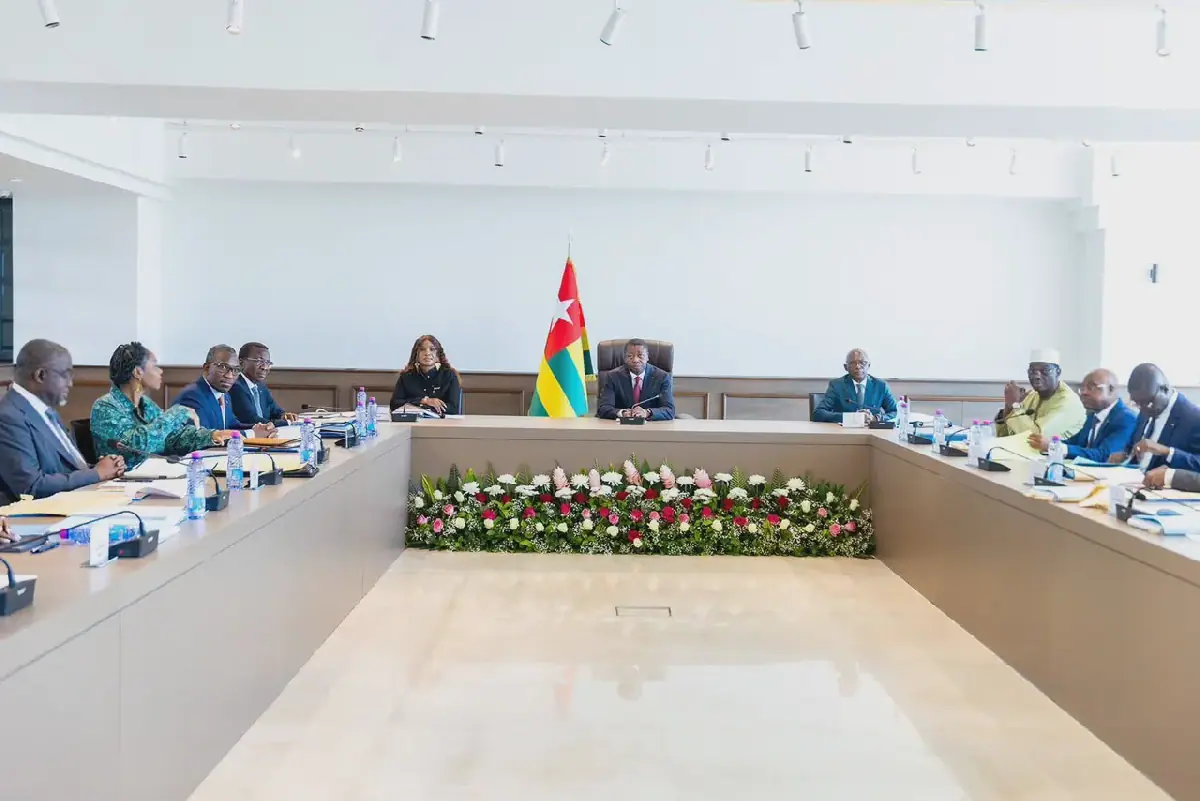
The Council of Ministers in Togo convened on November 6, 2026, under the leadership of President Faure Essozimna GNASSINGBE. During the meeting, the Council adopted one law and one decree, examined one law and one decree in the first reading, and heard three communications. One of the adopted laws was for the creation of the National Social Security Institute. This institute aims to unify the current social security system, which is managed by two separate entities: the Caisse de retraites du Togo and the Institut national d’assurance maladie.
The new National Social Security Institute will manage the retirement and health insurance regimes for public agents and their beneficiaries. The goal is to establish a single office for insured individuals and pool resources to improve service quality. This reform seeks to build a more integrated, equitable, and sustainable social protection system. It will ensure better care for public agents and their families throughout their careers and after retirement. The current system has several limitations, including duplicated structures, increased management costs, and disparities in service quality.
The Council also examined a law modifying the 2018 land code in the first reading. The code, adopted in 2018, was an important step in modernizing land governance in Togo. However, its implementation revealed some shortcomings and difficulties. The proposed modifications aim to improve the legal framework by introducing innovations such as the creation of a National Land Observatory. This observatory will enhance land governance, and the use of technology will modernize land management.
The proposed changes to the land code also focus on securing customary and rural land rights, promoting equality between men and women in land access, and protecting agricultural land and natural resources. The modifications aim to address pastoral and climate issues, strengthen access procedures for foreigners, and combat speculation. Additionally, the changes seek to facilitate access to land and agricultural financing for young people and improve conflict resolution.
In the area of public enterprises, the Council adopted a decree specifying the application modalities of the law on the legal regime applicable to public enterprises. The law, adopted on April 1, 2025, introduced several innovations to strengthen the role of supervisory authorities and promote performance contracts between the state and public enterprises. The decree adopted provides details on the exercise of supervision, internal and external control, and performance contract monitoring.
The Council also examined a decree creating a national commission to combat illicit mining activities. The goal is to strengthen coordination among competent administrations to address the resurgence of illicit mining activities. These activities have worrying environmental, economic, health, and security consequences. The commission will enhance cooperation among stakeholders to combat illegal mining.
The Council heard a communication on the conclusions of the first national seminar for governors and prefects. The seminar, held on August 5-6, 2026, focused on strengthening territorial governance and improving collaboration between central administrations, deconcentrated services, and territorial authorities. The seminar provided a platform for discussing ways to enhance administrative collaboration, information sharing, and public project monitoring.
Key points
- The Togolese government has adopted a new law creating the National Social Security Institute to unify and improve the social security system for public agents.
- A decree was adopted to specify the application modalities of the law on the legal regime applicable to public enterprises in Togo.
- The Council examined modifications to the 2018 land code to improve land governance and address current challenges.