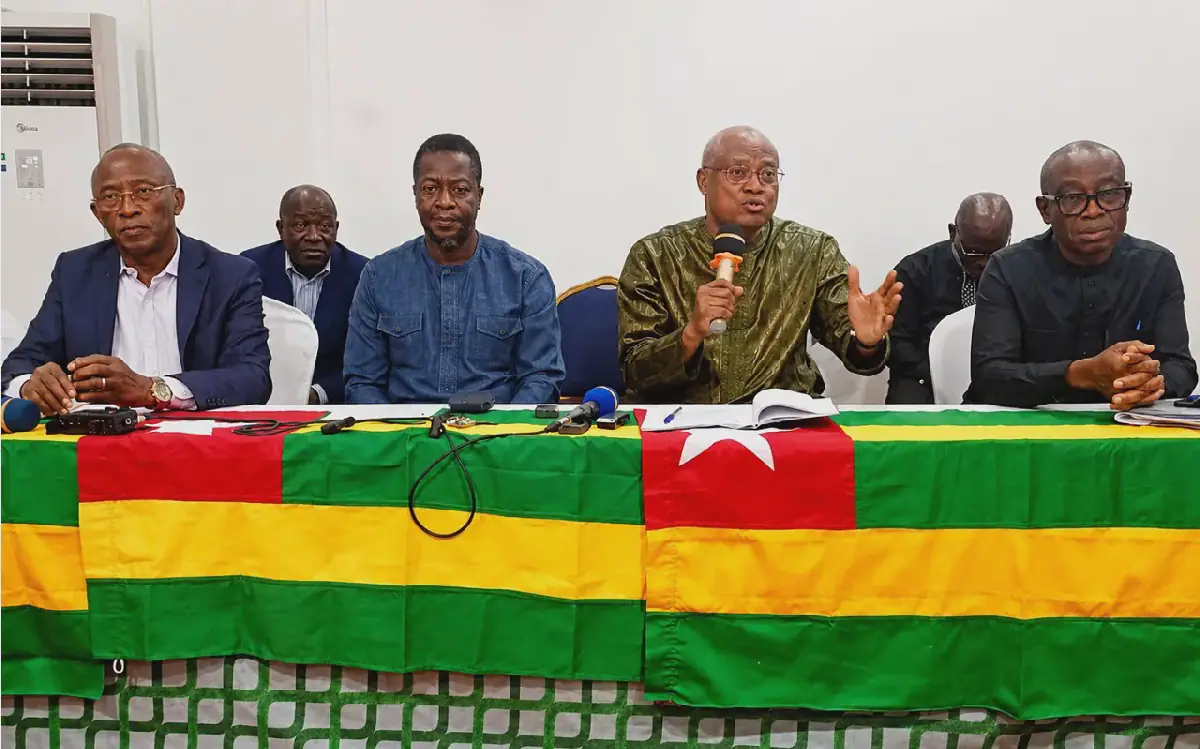
The Cadre national de concertation pour le changement (CNCC) in Togo has accused the government of infringing on the right to freedom of assembly. On November 8, 2026, during a meeting in Tsévié, the CNCC claims the government imposed administrative requirements, deployed excessive police forces, and arrested several activists. These actions were described as a systematic practice of restricting freedoms. The CNCC expressed gratitude to those who helped facilitate the meeting and invited the Togolese people to a large gathering in Lomé on December 13, 2026.
According to the CNCC, the Togolese government's actions demonstrate a blatant disregard for fundamental freedoms. The group stated that since they began organizing meetings and public conferences to discuss the transition to the Fifth Republic, the government has consistently imposed obstacles and intimidation tactics. These have included requiring documentation for meeting venues, excessive police presence, and arbitrary arrests of activists. The CNCC views these actions as a systematic attempt to suppress democratic debate and maintain an authoritarian grip on power.
The CNCC addressed a statement to Faure Essozimna Gnassingbé, President of the Council of Ministers, criticizing the government's handling of their meeting in Tsévié. They argued that the government's actions contravene the Togolese Constitution of 1992 and international principles of democracy and freedom. The CNCC questioned how long the country would continue to be an exception where exercising fundamental freedoms is treated as a crime. They also queried how long the government would prioritize the interests of a predatory minority over those of the majority.
The CNCC emphasized that freedom of assembly and association is not a favor granted by the government but a fundamental, inalienable right. They accused the government of attempting to stifle democratic debate and silence dissenting voices. The group argued that the government's actions reveal its fear of democratic change and its reliance on intimidation and coercion to maintain power. They called on the Togolese people to resist these attempts to suppress their freedoms.
The CNCC's statement also addressed the Togolese people, urging them to remain determined in their pursuit of justice and freedom. The group viewed the government's actions as a sign of weakness and fear of losing power. They argued that a government confident in its legitimacy would not need to employ such tactics to handle public dissent. The CNCC called for a renewed commitment to democratic principles and an end to the government's attempts to restrict freedoms.
The large gathering in Lomé on December 13, 2026, is seen as a crucial moment for the Togolese people to assert their rights and demand change. The CNCC has encouraged citizens to participate and show their support for democratic reforms. This event follows a similar meeting in Tsévié, which was marked by government interference and police presence. The CNCC remains committed to peaceful resistance and democratic activism.
The situation in Togo highlights the ongoing challenges facing democratic movements in the country. The CNCC's efforts to mobilize the public and push for change are seen as a significant development in the country's political landscape. The government's response to these efforts will likely have implications for the country's future trajectory. Key points:
Key points
- The CNCC accuses the Togolese government of systematically restricting freedoms.
- The government imposed administrative requirements and excessive police presence during a CNCC meeting in Tsévié.
- The CNCC has called for a large gathering in Lomé on December 13, 2026, to promote democratic reforms.