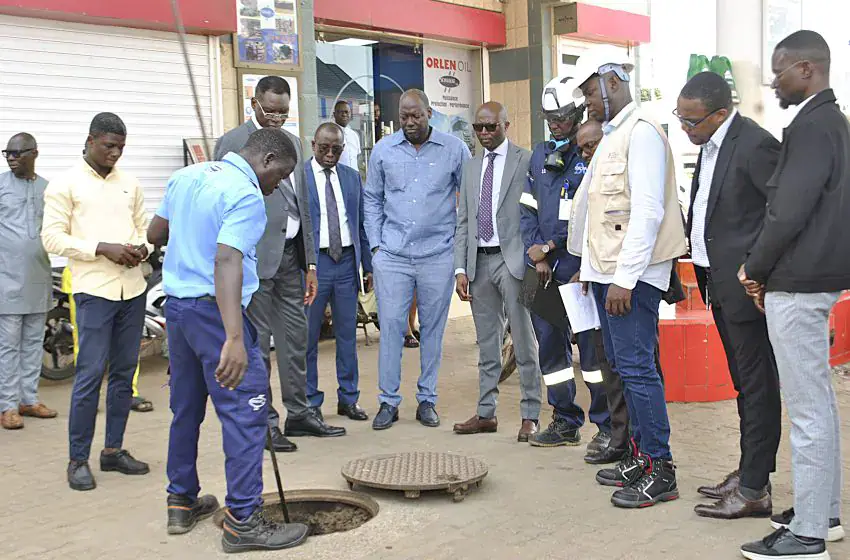
The Togolese government has started controlling the marking and tracing of petroleum products across the country. On November 2, 2026, the Commission overseeing the execution of the contract between the Togolese state and SICPA SA (CSECES) began inspecting petroleum products in service stations in Lomé using two mobile laboratories. This operation aims to verify the presence of a marker in the fuels sold and ensure the smooth running of control operations.
The inspection teams consist of agents from the Office Togolais des Recettes (OTR), the Ministry of Commerce, the Commission, and SICPA laboratory technicians. They visited several service stations in Lomé, including the general management of Compagnie Africaine de Pétrole au Togo (CAP-Togo SA), Somayaf-Togo Jean Paul II, TotalEnergies de Dzifa-Kpota, Zener Kanyikopé, CAP Aéroport, and T-Oil de Baguida. The control process involves taking a 500 ml sample of fuel, analyzing it on-site in the mobile laboratory, and verifying the presence of the fiscal marker provided by the Automated Marking Solution (SAM).
This operation aims to verify the presence of the marker in the distributed fuels and assess the practical conditions for conducting tests using mobile laboratories. It also allows stakeholders to observe the implementation of the system, the sampling operations, and the analysis of the results. The goal is to ensure that the procedures for sampling, handling, and analyzing samples are respected. The Togolese government launched the marking and tracing operation of petroleum products on July 31, 2026.
For decades, the illicit circuit of petroleum products has been a parallel economy deeply ingrained in the habits of many Togolese citizens. The trafficking of adulterated fuel deprives the state of valuable customs revenue. Beyond the fiscal loss, the phenomenon has become a major national security issue. The fuel stored in undeclared locations causes recurrent fires. The president of the Commission, Esso-Wavana Ahmed Adoyi, stated that this activity aims to inform economic operators and consumers about the objectives, stakes, and benefits of this new phase of reforms.
The objective is to monitor and preserve the quality of products derived from hydrocarbons, avoiding the multiple consequences of illicit fuel. Sosso Balam Tchamdja, general manager of SICPA Togo SAU, indicated that the control aims to verify the level of conformity of products served to consumers using specific instruments. He expressed satisfaction with the work done upstream and the conformity of products observed on the ground.
In its dynamic of modernizing economic governance, the Togolese state has just reached a decisive step to eradicate illegal trade and smuggling, guarantee the quality of fuels to consumers, and preserve fiscal revenue in the face of the scourge of parallel circuits. By cleansing the hydrocarbon sector, Togo sends a strong signal to development partners and investors, that of a transparent, regulated, and consumer-protecting market.
The effective control of petroleum product marking and tracing is a significant step towards improving transparency and protecting consumers in Togo. The operation will help to prevent the sale of adulterated fuels, reduce the risk of fires, and increase customs revenue. The Togolese government is committed to ensuring the quality of petroleum products and preventing the illicit trade of fuels.
Key points
- The Togolese government has launched a nationwide control of petroleum product marking and tracing using mobile laboratories to verify the presence of a fiscal marker.
- The operation aims to prevent the sale of adulterated fuels, reduce the risk of fires, and increase customs revenue.
- The effective control of petroleum product marking and tracing is a significant step towards improving transparency and protecting consumers in Togo.