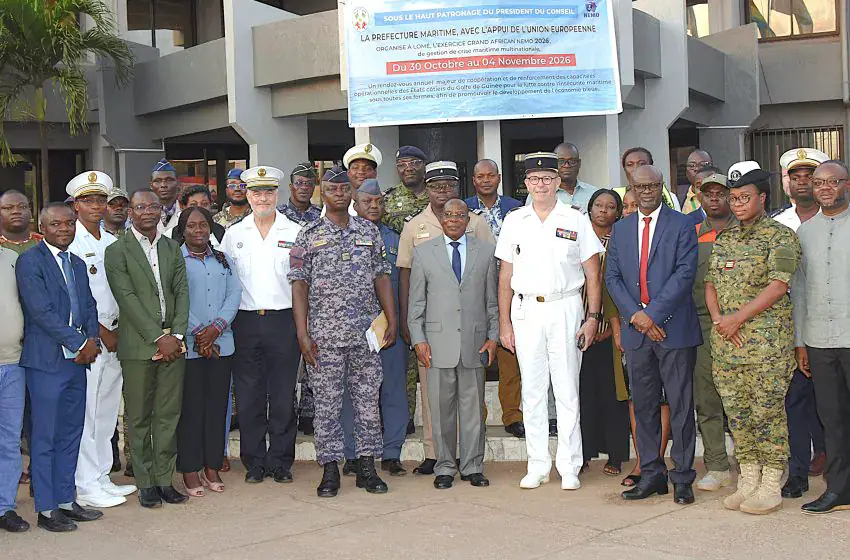
The 9th edition of the Grand African Nemo (GANo) maritime exercise, held in Lomé, Togo, from October 30 to November 4, 2026, has concluded. The exercise, organized by the Togolese Maritime Prefecture in partnership with the European Union, brought together nearly 360 personnel from 24 administrations. The primary objective of GANo 26 is to strengthen the capabilities of administrations involved in maritime security, train naval and air units to combat maritime crime, and improve crisis management.
The GANo 26 exercise takes place against the backdrop of persistent threats in the Gulf of Guinea, including piracy, armed robbery, hostage-taking, illegal fishing, and drug trafficking. These illicit activities compromise maritime safety and security, hindering the development of the blue economy. To address these challenges, Gulf of Guinea states have established the Yaoundé Architecture, a cooperation mechanism aimed at protecting their maritime spaces. GANo 26 is part of this effort, aiming to enhance the operational level of maritime actors and their collective response to threats.
During the exercise, participants were confronted with three scenarios: combating fires and water ingress on ships, responding to marine pollution, and countering arms and narcotics trafficking. These maneuvers tested intervention capabilities, team coordination, and the responsiveness of different administrations to emergency situations. According to Togolese Maritime Prefect Colonel Takougnadi Neyo, the exercise was a success, enabling Togo to strengthen national competencies and improve coordination between administrations.
Colonel Neyo attributed the success to the new maritime governance established under the impetus of President Faure Essozimna Gnassingbé, which includes the creation of the National Organ for Maritime State Action (ONAEM), the High Council for the Sea, and the Maritime Prefecture. These structures aim to enhance maritime safety and security through inter-ministerial and operational coordination. Neyo urged participants to continue their efforts to guarantee the permanent security of port installations and maritime spaces.
The exercise demonstrated the importance of cooperation and coordination in addressing maritime security challenges. The Gulf of Guinea region faces significant threats to its maritime security, and exercises like GANo 26 are crucial in enhancing the capabilities of regional actors to respond to these threats. The success of the exercise highlights the progress made by Togo in strengthening its maritime security architecture.
In his closing remarks, Laré Penn, head of cabinet of the High Council for the Sea, emphasized that maritime security is an imperative of sovereignty, a factor of regional stability, and a condition essential to economic prosperity. He highlighted Togo's ambition to consolidate its position as a logistics platform and reference business center in West Africa, which relies on the competitiveness of its port installations, maritime security, and the trust of economic operators.
Penn outlined three priorities for the next phase: improving the fluidity and security of information exchanges between national and regional structures, continuing the implementation of the national maritime strategy, and strengthening joint operations and judicial cooperation against illicit activities at sea. The conclusion of the exercise marks the beginning of a new phase focused on capitalizing on lessons learned, correcting shortcomings, and consolidating best practices.
Key points
- The exercise brought together nearly 360 personnel from 24 administrations to enhance maritime security and crisis management in the Gulf of Guinea.
- The exercise aimed to strengthen the capabilities of administrations involved in maritime security, train naval and air units to combat maritime crime, and improve crisis management.
- Togo's maritime security architecture has been strengthened through the creation of new structures, including the National Organ for Maritime State Action (ONAEM) and the High Council for the Sea.