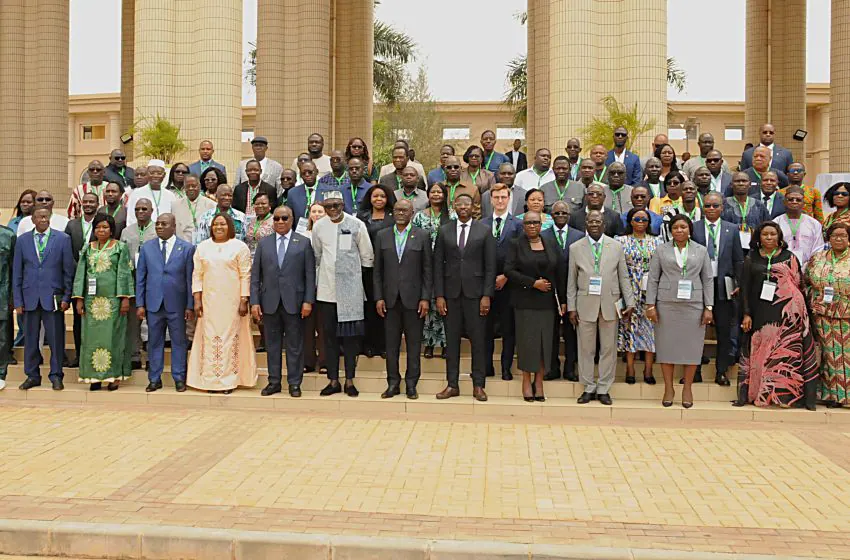
The seminar, held on October 2-3, 2026, at the National Assembly in Lomé, Togo, aims to address the issue of plastic pollution through a legislative approach. The event, organized in collaboration with the International Organization of La Francophonie (OIF) and the Parliamentary Assembly of La Francophonie (APF), gathered deputies, senators, local officials, civil society organizations, researchers, and public administrations. The seminar's approach is centered around "listening, understanding, and legislating" to effectively tackle the problem.
The seminar's discussions focused on the international treaty on plastic pollution, regional dynamics, and the national framework, with a specific emphasis on legislative levers. Participants examined ways to reduce single-use packaging, the role of extended producer responsibility in financing waste management, and fiscal and financial instruments that could support the transition to a circular economy. The goal is to address the economic, social, environmental, and health dimensions of plastic pollution.
In his opening remarks, National Assembly President Komi Selom Klassou highlighted the urgent need for action against plastic pollution, describing it as a "silent invader" that affects not only the environment but also public health and the economy. He emphasized that the problem is not insurmountable and that conscious choices in production and consumption can mitigate its effects. Klassou expressed gratitude to the APF and OIF for their support and encouraged participants to work towards creating a legislative framework that addresses the issue.
The seminar's objectives include regaining sovereignty over the plastic cycle and placing the Parliament at the forefront of ecological transformation. Klassou invited participants to consider the circular economy as a source of green job creation for young people and to support waste collection and recycling enterprises. He outlined the seminar's methodology, which involves listening to experiences, confronting solutions with national realities, and drafting coherent and applicable legislation.
Bakary Junior Bamba, representing the OIF, recalled that the seminar is part of a strategic partnership between the OIF and APF, formalized in 2014. He emphasized that the Francophonie is not only a space for shared values but also a platform for exchanging experiences and solutions. Bamba highlighted the urgent need for action, citing the staggering statistics on plastic consumption and waste generation.
According to the United Nations Environment Programme, humanity consumed over 500 million tons of plastic in 2024, with the global waste expected to almost triple by 2060 if no urgent action is taken. The seminar's discussions are expected to lead to the development of a legislative proposal adapted to the Togolese context. The APF's Secretary General, Amélia Lakrafi, welcomed the seminar, noting that the proposed legislative framework offers concrete solutions, including targeted bans on single-use plastics, extended producer responsibility, and sustainable public procurement.
The seminar is a follow-up to a previous event on climate change held in February 2025 and aims to translate discussions into concrete actions. The event brought together a diverse range of stakeholders, including the International Association of Francophone Mayors, highlighting the importance of local action in addressing the issue of plastic pollution. The outcome of the seminar is expected to contribute to the development of effective legislation to combat plastic pollution in Togo and beyond.
Key points
- Togo's National Assembly hosts a seminar to discuss and legislate on plastic pollution.
- The seminar aims to address the issue through a legislative approach, with a focus on reducing single-use packaging and promoting a circular economy.
- The event is part of a broader effort to combat plastic pollution, with the goal of developing effective legislation to address the issue in Togo and beyond.