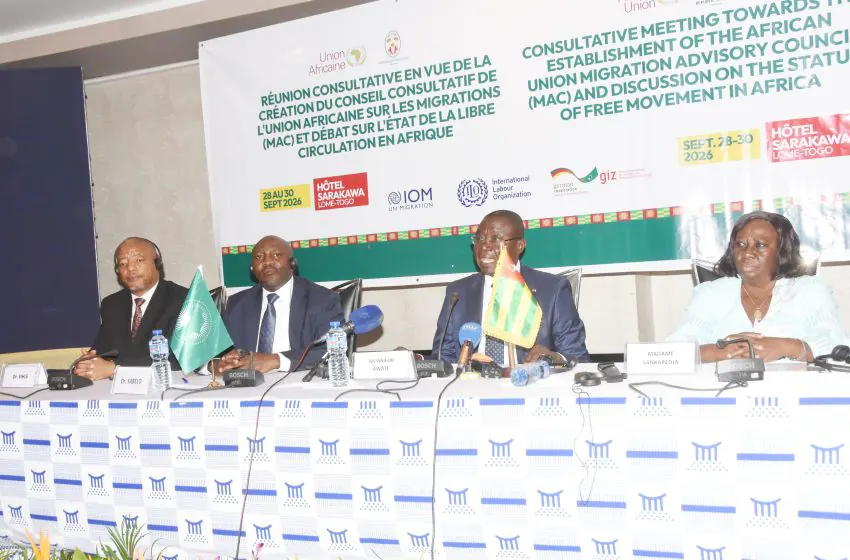
Lomé, Togo, is hosting a three-day meeting from September 28 to 30, 2026, to establish the African Union's Migration Advisory Council. The council aims to harmonize African responses to mobility, migration governance, and border management challenges. Representatives from immigration services and regional economic communities are attending the meeting to lay the groundwork for the new mechanism.
The meeting's objectives include examining the modalities for setting up the advisory council, its role in African migration governance, and its priority areas. Participants are discussing various issues, such as current migration practices, obstacles to mobility, modernization and interconnection of borders, digitalization of procedures, and improvement of information systems and data management. The goal is to strengthen institutions and translate continental commitments into concrete actions.
The Togolese government views the meeting as an opportunity to demonstrate its commitment to an open Africa. The country's Minister of Territorial Administration, Decentralization, and Traditional Chiefs, Colonel Hodabalo Awaté, noted that African migration is shaped by demographic growth, urbanization, economic transformations, labor needs, and environmental changes. He cited the recent decision to waive prior visa requirements for all African nationals, with visa issuance upon arrival, as an example of Togo's open approach.
The meeting's participants, including representatives from partner organizations, agree on the need for a permanent mechanism to strengthen migration governance and make mobility a lever for integration and development. The representative of the African Union Commissioner for Health, Humanitarian Affairs, and Social Development, Dr. Sabelo Lyndon, emphasized that the advisory council should enable better responses to migration and border challenges and promote a common African voice on free movement.
The International Labor Organization (ILO) is focusing on employment and workers' rights, stressing that free movement should facilitate access to economic opportunities while ensuring social protection, portability of rights, fair recruitment, and employer involvement in the council's work. The ILO representative highlighted the importance of considering labor migration in the advisory council's work.
The meeting's outcomes are expected to provide concrete orientations for the establishment of the Migration Advisory Council. The council's creation is seen as a crucial step towards implementing the African Union's vision of free movement and border management. The Togolese government's initiative is part of its broader efforts to promote regional integration and economic development.
The meeting in Lomé marks a significant milestone in the development of the African Union's migration policy. The 20th anniversary of the African Migration Policy Framework, which considers migration an opportunity, provides a fitting backdrop for the establishment of the advisory council. The council is expected to play a key role in promoting a coherent and comprehensive approach to migration governance in Africa.
Key points
- The African Union's Migration Advisory Council aims to harmonize African responses to mobility, migration governance, and border management challenges.
- The Togolese government has waived prior visa requirements for all African nationals, with visa issuance upon arrival, as part of its open approach to migration.
- The advisory council's establishment is seen as a crucial step towards implementing the African Union's vision of free movement and border management.