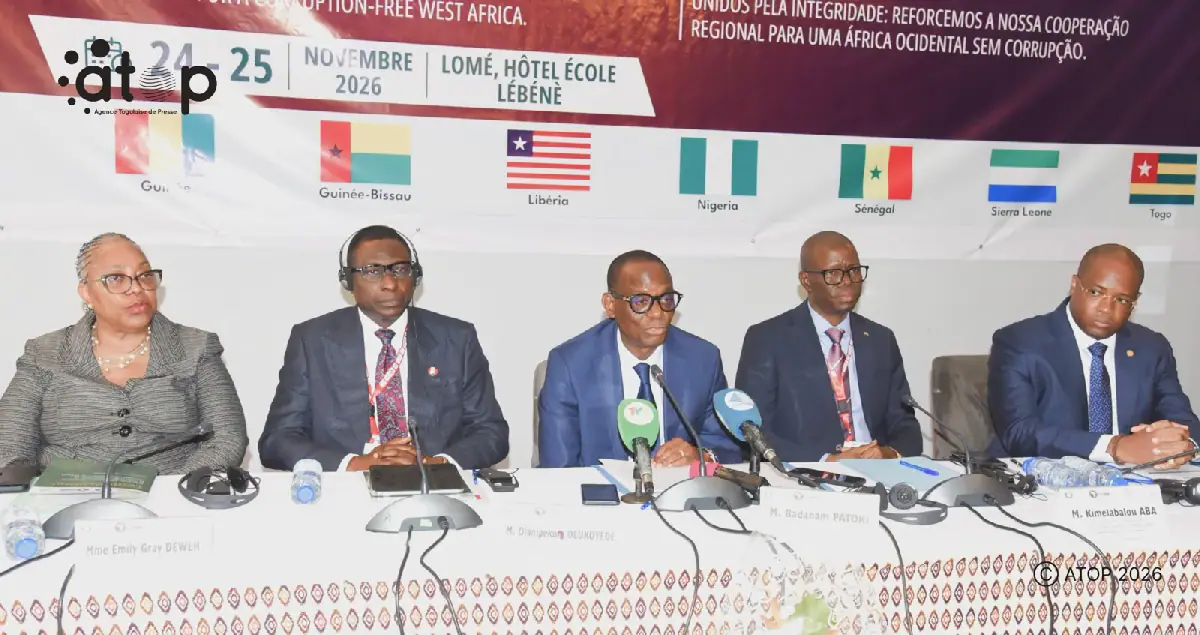
The 8th General Assembly of the Network of National Institutions for Combating Corruption in West Africa (RINLCAO) opened on November 24 in Lomé, Togo. The event is organized by the High Authority for the Prevention and Fight against Corruption and Related Offenses (HAPLUCIA) under the theme "United for Integrity: Strengthening Regional Cooperation and Collective Action against Corruption in West Africa". The assembly aims to review RINLCAO's institutional progress, enhance regional cooperation among member institutions, and agree on strategic and operational priorities for the next implementation period.
The two-day meeting brings together delegates from RINLCAO member institutions, the executive committee, and the permanent secretariat, as well as representatives from the Economic Community of West African States (ECOWAS) Commission, technical and financial partners, and civil society organizations. Discussions will focus on implementing the ECOWAS protocol on combating corruption, the emerging challenge of cybercrime in Africa, and practical mechanisms to strengthen information exchange, mutual legal assistance, and asset recovery.
The representative of the President of the Council, Minister of Economy and Strategic Monitoring, Badanam Patoki, emphasized that corruption remains a major obstacle to good governance, sustainable development, and consolidation of the rule of law. Despite notable progress, he stressed that the work is far from over. Patoki recommended three key imperatives to guide the discussions: protecting the sub-regional space against crimes that threaten security, bringing together institutions and expertise for sustainable anti-corruption efforts, and periodically revisiting strategies to adapt to evolving corrupt practices and population expectations.
Aba Kimelabalou, President of HAPLUCIA and Secretary General of RINLCAO, highlighted the importance of unity and cooperation in the fight against corruption. He noted that no national institution can effectively combat corruption in isolation and that the general assembly is an opportunity to share experiences, examine challenges, and identify best practices to improve performance. The assembly's discussions will also focus on reviewing the network's statutes, internal regulations, and financial reports.
The assembly will examine two key thematic areas: "From Protocol to Practice: Advancing the Implementation of the ECOWAS Protocol on Combating Corruption" and "The Emerging Challenge of Cybercrime in Africa: How Foreign-Managed Scam Centers Exploit Corruption and Institutional Vulnerabilities to Threaten Digital Security". Participants will identify practical mechanisms to strengthen cooperation and collective action against corruption.
A closed session reserved for RINLCAO member institutions will focus on reviewing the network's statutes, internal regulations, and financial reports. The event is expected to conclude on November 25, with participants adopting key recommendations and a roadmap for the next phase of RINLCAO's implementation.
The 8th General Assembly of RINLCAO is taking place against the backdrop of growing concerns about corruption and its impact on development in West Africa. The event demonstrates the commitment of regional institutions to fighting corruption and promoting good governance. Key points from the assembly include the need for strengthened regional cooperation, effective implementation of anti-corruption protocols, and enhanced mechanisms for asset recovery and mutual legal assistance.
Key points
- The 8th General Assembly of RINLCAO aims to strengthen regional cooperation and collective action against corruption in West Africa.
- The event brings together delegates from RINLCAO member institutions, ECOWAS Commission, and civil society organizations to discuss key thematic areas.
- The assembly will review RINLCAO's institutional progress, agree on strategic priorities, and identify practical mechanisms to combat corruption.
Reporting sources
- HAPLUCIA : Ouverture des travaux de la 8e assemblée générale du RINLCAO · Togolese Press Agency