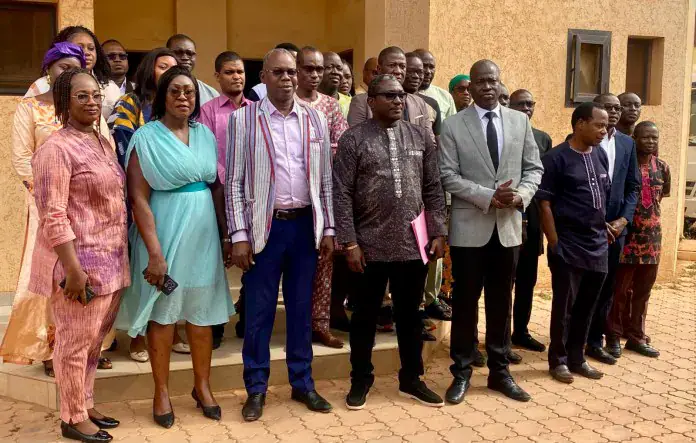
The Burkinabé Ministry of Justice launched a three-day training session in Ouagadougou on November 24, 2026, for judicial and economic actors on banking regulations in the UEMOA and OHADA spaces. The session aimed to explore the legal and regulatory foundations of current bank accounts, examine their operating mechanisms, and discuss issues related to their closure and resulting disputes. This initiative was taken to address the lack of knowledge on the legal regime of current bank accounts, which is a source of litigation.
The training session was led by Dr. Alain Zerbo, a chamber president at the Court of Appeal, who explained that the participants would be provided with tools to understand the origin of current bank accounts, the obligations of parties, and the functioning and closure of accounts. Dr. Zerbo identified two main categories of disputes: the closure of accounts, where clients and banks often disagree on the balance, remuneration, and agios, and contradictory closure, where banks do not involve clients in the process, leading to numerous contestations before courts.
The session also addressed guarantees associated with current bank accounts, such as mortgages and pledges, as well as the fate of the balance in case of collective proceedings against clients. According to Valéry Jean Prosper Silga, the permanent secretary of the National OHADA Commission, the theme of this training session is particularly important, as current bank accounts have rarely been the subject of legislative concern, and jurisprudence, doctrine, and banking practices are essential sources for finding solutions.
Jean François Bilgo, representing the Minister of Justice, emphasized the importance of current bank accounts in the UEMOA space, describing them as the central technical and legal instrument of the relationship between credit institutions and their clients. He noted that this relationship raises sensitive legal questions, such as the nature and regime of the account balance, compensation mechanisms, and the modalities and consequences of account closure.
The complexity of the matter is also due to the superposition of multiple norms, including UEMOA regulations, BCEAO and Banking Commission instruments, and OHADA uniform acts on securities, collective proceedings, and enforcement procedures. Bilgo stressed the need for anticipation, as there are often disputes that do not yet have legal provisions to manage them at the level of jurisdictions.
The training session was organized by the Ministry of Justice, through the permanent secretariat of the National OHADA Commission, to equip judicial and economic actors with the necessary tools to understand and manage current bank account regulations. The session brought together various actors, including judges, lawyers, and banking professionals, to discuss the challenges and opportunities presented by current bank accounts in the UEMOA and OHADA spaces.
The participants were provided with a comprehensive understanding of the legal and regulatory framework governing current bank accounts, as well as the mechanisms for resolving disputes related to their closure. The training session is expected to contribute to the improvement of the management of current bank accounts and the reduction of disputes related to their closure.
Key points
- The Burkinabé Ministry of Justice organized a training session on banking regulations in the UEMOA and OHADA spaces to address the lack of knowledge on the legal regime of current bank accounts.