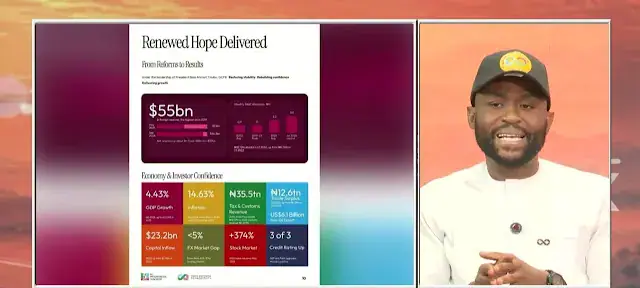
A support group for President Bola Tinubu, the Data Analytics Group for Asiwaju (DAGFA), has urged Nigerians to be patient with the country's economic reforms, citing improvements in national economic indicators. DAGFA spokesperson Niyi Sodipo made the appeal during an appearance on Arise News' Daybreak, where presenters questioned the funding and delivery of the administration's proposed second-term programme. Sodipo argued that policies introduced since 2023 had helped stabilise the economy.
The discussion centred on the distance between the administration's economic claims and the circumstances of low-income households. Sodipo acknowledged the difficulties faced by many families, but argued that sustained stability would eventually help businesses obtain finance, expand operations, and employ more workers. He cited a World Bank assessment that poverty had stabilised, while accepting that stabilisation did not mean poverty had fallen.
The World Bank's October 2026 assessment reported that poverty had stopped rising after successive increases since 2019. However, it stressed that poverty remained high and that better jobs, higher real incomes, and lower inflation were necessary to improve living standards. Sodipo also called for greater scrutiny of state and local governments, arguing that higher public revenues would improve daily life only if officials used them effectively.
The presenters challenged Sodipo to identify a reform that had directly benefited an ordinary low-income family, excluding the Nigerian Education Loan Fund. Sodipo cited petrol subsidy removal and improved fuel availability, as well as government payments to vulnerable Nigerians. However, he warned that excessive cash injections could add to inflationary pressure. He also referred to his own business, which had continued employing workers through the reform period.
The discussion then turned to whether the government had sufficient revenue to finance its commitments. The presenters cited first-quarter budget figures showing that debt service absorbed approximately 91 per cent of federal revenue. They questioned how the administration intended to fund development while managing debt obligations, recurrent expenditure, and overlapping budget implementation periods.
Sodipo accepted that debt-service costs required attention but argued that the use of borrowed funds deserved greater emphasis. He maintained that "debt is not a problem for us right now" and referred to the International Monetary Fund's assessment in defending the government's position. The IMF's 2026 debt assessment placed Nigeria's overall risk of sovereign stress at a moderate level.
On inflation, Sodipo defended the administration's record and said the next programme aimed to bring the rate down to eight per cent by 2031. He separately identified six per cent annual economic growth as the government's target. The latest published September figures put headline inflation at 14.63 per cent, compared with 15.39 per cent in August.
Key points
- The support group urges Nigerians to be patient with economic reforms.
- The World Bank reports that poverty has stabilised but remains high.
- The government aims to bring inflation down to eight per cent by 2031.
Reporting sources
- Tinubu group urges patience on reforms · Prime 9ja Online