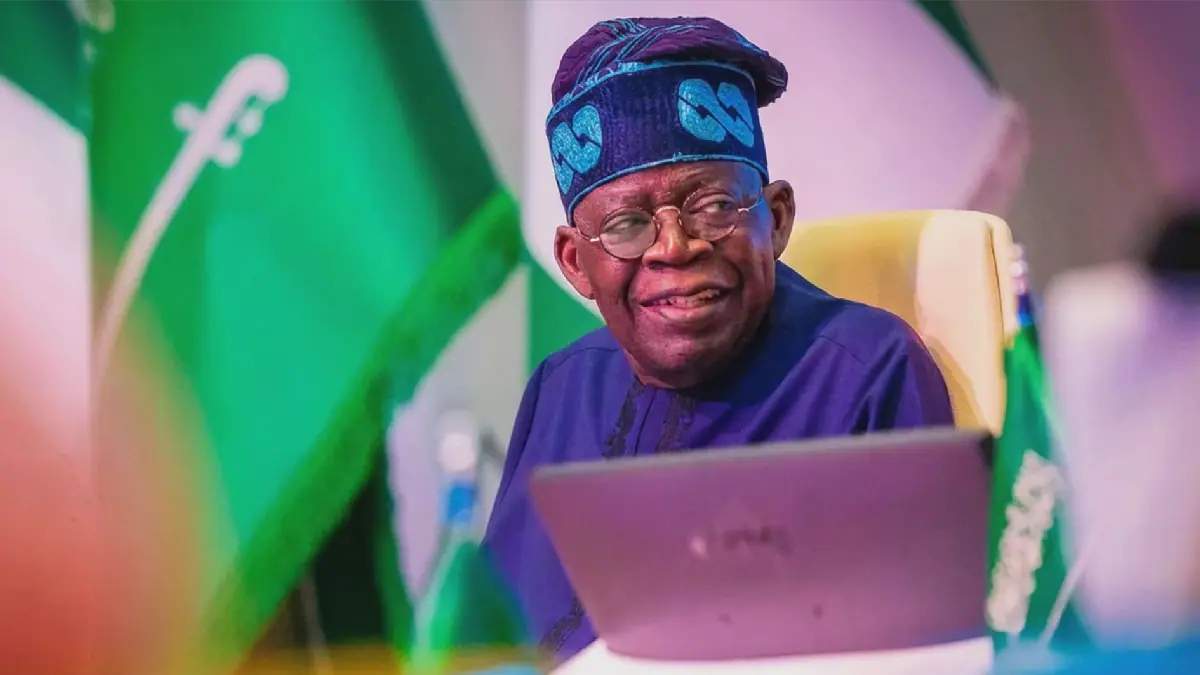
President Bola Tinubu has reiterated his administration's commitment to maintaining the removal of fuel subsidy, a decision that has been a subject of controversy and debate in Nigeria. During a meeting at the Aso Rock Villa with City Boys, a campaign group driven by his son, Seyi Tinubu, the President declared that Nigeria would not return to the subsidy regime. He cited the country's economic growth, which has reached 4.6%, and warned of dire consequences if the subsidy is reinstated.
Tinubu's statement appears to be a response to opposition politicians, including former Vice President Atiku Abubakar, who has promised to restore fuel subsidy if elected in 2027. Abakar's proposal has gained traction among some Nigerians who are struggling with the high cost of living. However, Tinubu argued that removing the subsidy was necessary, citing the country's improving macroeconomic performance. He also referenced his scripture studies, comparing the decision to the biblical account of Moses and the Israelites leaving Egypt.
The President's statement was also seen as a response to officials of the International Monetary Fund (IMF), who recently cautioned Nigeria against restoring fuel subsidy during the IMF/World Bank Annual Meetings in Thailand. The IMF had warned that reinstating the subsidy could have negative consequences for Nigeria's economy. Tinubu's administration has been working to implement economic reforms, including the removal of fuel subsidy, which has saved an estimated N4 trillion.
The fuel subsidy regime was introduced in 1973 as a temporary measure to cushion the effects of a sharp increase in international oil prices. However, it gradually became a form of entitlement that the masses were reluctant to relinquish. The subsidy has been a major drain on Nigeria's economy, with the country struggling to fund it. In 2024, banks declared profits of N6.7 trillion, the highest in Nigeria's history, but 133 million Nigerians were living in multidimensional poverty, according to a recent World Bank survey.
The cost of living in Nigeria has increased significantly, with the cost of transportation from Oshodi to CMS in Lagos quadrupling from N300 to N1,200. The price of petrol has also increased by about 80% since the subsidy was removed. Despite this, Tinubu's administration has maintained that the removal of the subsidy was necessary to achieve economic growth and stability. The President's statement has been seen as a reaffirmation of his commitment to economic reform.
Finance Minister Taiwo Oyedele has also warned that a return to fuel subsidy could push the exchange rate to N4,000 to the dollar and petrol prices to N5,000 per litre. Oyedele announced measures to modulate petrol prices on October 8, which some opposition politicians and concerned Nigerians have characterised as a possible return to subsidy under a complex policy terminology.
Tinubu's administration has achieved significant macroeconomic improvements, including a GDP growth rate of 4.3-4.6% over the past three years, its highest level in ten years. However, the administration still faces challenges in translating these improvements into relief at the microeconomic level. The President's commitment to maintaining the removal of fuel subsidy is seen as a key aspect of his economic reform agenda.
Key points
- President Tinubu reaffirms Nigeria's commitment to fuel subsidy removal.
- The decision has contributed to Nigeria's economic growth, which has reached 4.6%.
- Reinstating the subsidy could have negative consequences for Nigeria's economy, including an exchange rate of N4,000 to the dollar.