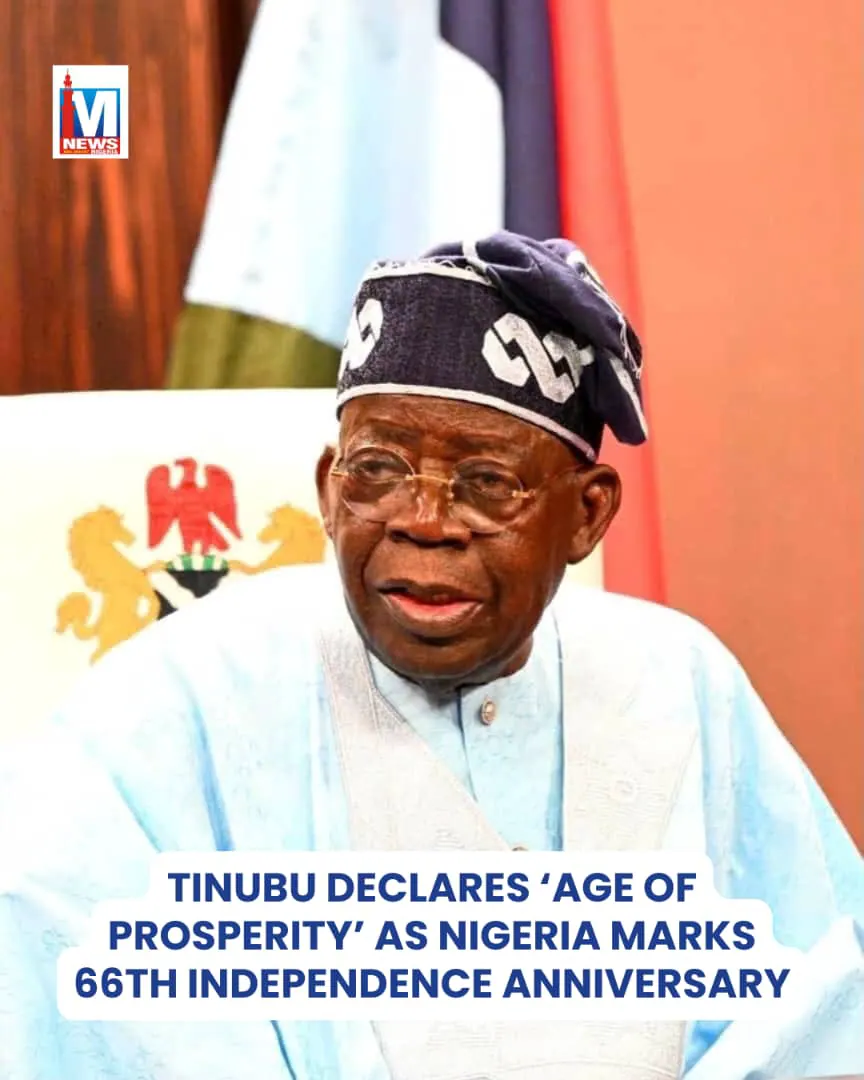
President Bola Ahmed Tinubu has declared that Nigeria has moved beyond the phase of economic reforms and entered an "age of prosperity". In his Independence Day address on October 1, Tinubu promised to focus his administration on lowering the cost of living, creating jobs, and expanding opportunities for Nigerians. He said his administration had taken difficult economic decisions since assuming office to address longstanding weaknesses and distortions in the economy.
Tinubu likened Nigeria's economic situation to a patient diagnosed with cancer who must undergo difficult treatment to recover. He argued that his administration's reforms did not create the weaknesses in the economy but were designed to confront them. According to Tinubu, Nigeria's economy had grown by more than four per cent in 2026, with both the oil and non-oil sectors contributing to a period of stable growth.
The President cited lower oil theft, falling inflation, rebuilt foreign reserves, and a more stable foreign exchange market among the gains recorded under his administration. He also mentioned that Nigeria recorded its highest revenue from non-oil exports in 2025, exceeding $6 billion. Tinubu said the economic focus of his administration had changed from correcting the country's economic direction to achieving "shared and widespread prosperity".
Tinubu identified the reduction of the cost of living as an immediate priority, saying the government would seek to lower the cost of producing and transporting goods. He listed mechanised irrigation, dry-season farming, improved access to seeds and fertiliser, agricultural mechanisation, storage, and transportation among measures being pursued to increase food production. He also pointed to investments in roads, railways, and ports to improve connections between farms, factories, and markets.
The President said jobs, enterprise, and industrial growth would remain central to the government's policies. He said the administration would use Nigeria's gas resources to power industries, support businesses seeking to revive factories, expand digital connectivity, and invest in skills and financing for businesses. Tinubu expressed his desire to see more Nigerians making things, more Nigerian farms feeding cities and supplying factories, and Nigerian businesses selling goods to the whole world.
Tinubu acknowledged that millions of Nigerians still struggle with food, education, healthcare, and transportation costs. He highlighted direct support for poorer households, improvements to the National Social Register, the Nigerian Education Loan Fund, consumer credit through CREDICORP, and continued investments in primary healthcare and basic education. The President said the government could not erase in four years challenges that had accumulated over generations but could change the country's direction.
Tinubu concluded with a call for Nigerians to move forward with confidence in the country and its future. He described the future Nigeria as a country of "abundance and opportunity", where prosperity is broadly shared and children can dream beyond the circumstances of their birth. The President urged Nigerians to look ahead rather than dwell on past difficulties, saying the government had corrected the country's economic course.
Key points
- President Tinubu declares Nigeria has entered an "age of prosperity" after economic reforms.
- The government aims to focus on lowering the cost of living, creating jobs, and expanding opportunities for Nigerians.
- Tinubu acknowledges that achieving broad prosperity will require time, discipline, sustained economic growth, and the creation of millions of productive opportunities.