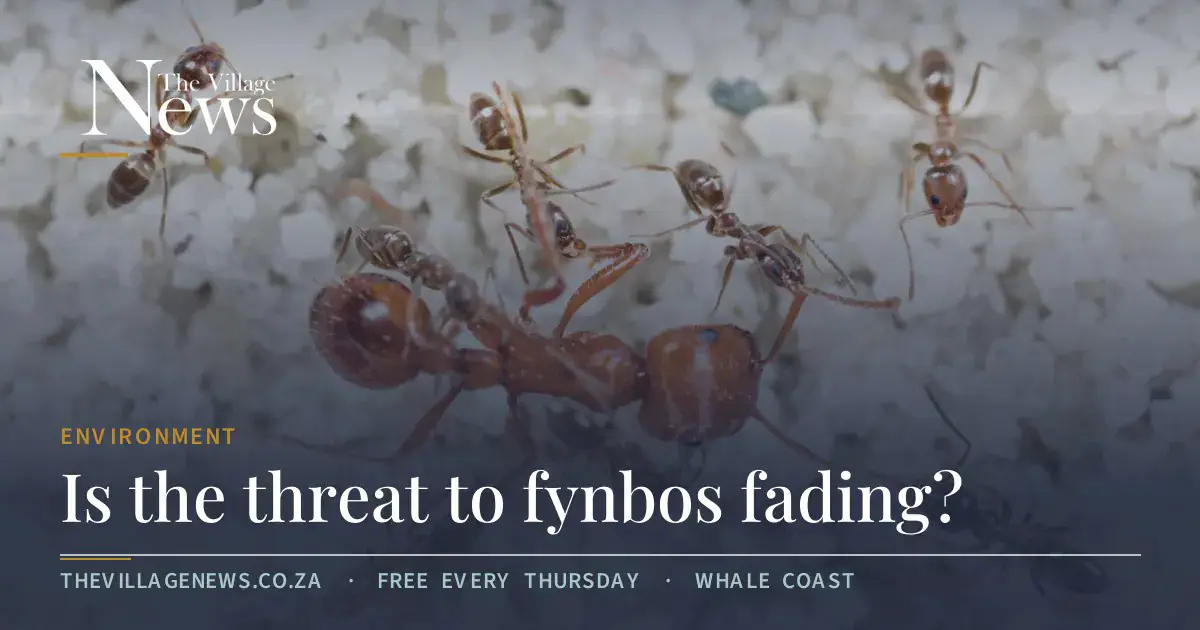
For decades, the Argentine ant has been considered a serious threat to South Africa's unique fynbos ecosystem. The tiny creature's invasion was thought to disrupt the relationship between indigenous ants and plants whose seeds they dispersed, potentially harming hundreds of plant species. However, a recent observation by naturalist Peter Slingsby suggests that this may be changing. Slingsby, who helped raise the alarm in a 1984 scientific paper, now believes the Argentine ant may be losing its dominance in parts of the Western Cape.
The fynbos ecosystem relies on an extraordinary partnership between plants and indigenous ants. Many fynbos plants produce seeds with a nutritious appendage called an elaiosome, which attracts indigenous ants. These ants carry the seeds underground to their nests, eat the elaiosome, and leave the seed intact, often in a protected chamber where it can germinate after fire-driven heat and chemical triggers. This process, known as myrmecochory, is crucial in fynbos, as seeds buried underground are less likely to be eaten by predators or destroyed in the next fire.
The Argentine ant, originating from South America, disrupts this vital seed-dispersal and protection service. It takes the nutritious reward but leaves the seed on the soil surface, exposed to predators and fire. As they expand their territory, they displace indigenous ants, interrupting the delicate balance of the fynbos ecosystem. Research by botanist William Bond and Slingsby demonstrated that the invasion could change fynbos vegetation composition, with large-seeded plants being particularly vulnerable.
However, Slingsby now reports a surprising development. He and Bond revisited sites, including Oudebos and Rooisand, where Argentine ants had previously been in abundance. They observed that indigenous species had displaced the invader. Slingsby also reports that Argentine ants have disappeared from many of Cape Town's southern suburbs, and other rural localities seem to have far fewer of them. Three indigenous ants, Lepisiota capensis, Pheidole megacephala, and Technomyrmex pallipes, appear to have developed ways of competing successfully with the Argentine ant.
Interestingly, these indigenous ants have become invasive pests in different parts of the world. Slingsby acknowledges that his recent observations need to be formally published, and a comprehensive survey is required to determine the true extent of the change. This development is tentatively encouraging news for conservationists, but also a reason to keep watching. Ecosystems are dynamic, and indigenous species can sometimes resist or adapt to an introduced competitor.
However, recent research suggests that the Argentine ant threat should not be written off just yet. A study published in 2025 revealed that in invaded areas of the Cape, the ant continued to disrupt seed-dispersal relationships in ways that favoured highly invasive acacias over indigenous plants. The ecological consequences may therefore extend beyond the original concern about fynbos regeneration.
The most accurate conclusion is that the Argentine ant threat may be declining in some parts of the Cape, rather than disappearing altogether. Conservationists will need to continue monitoring the situation to understand the full implications of this development. If confirmed, this change could be a welcome resolution to one of South Africa's most persistent ecological worries.
Key points
- Indigenous ants appear to be displacing Argentine ants in some areas of the Western Cape.
- The Argentine ant threat may be declining, but a comprehensive survey is needed to confirm the extent of the change.
- The ecological consequences of the Argentine ant invasion may extend beyond fynbos regeneration, favouring invasive acacias over indigenous plants.
Reporting sources
- Is the threat to fynbos fading? · Village News