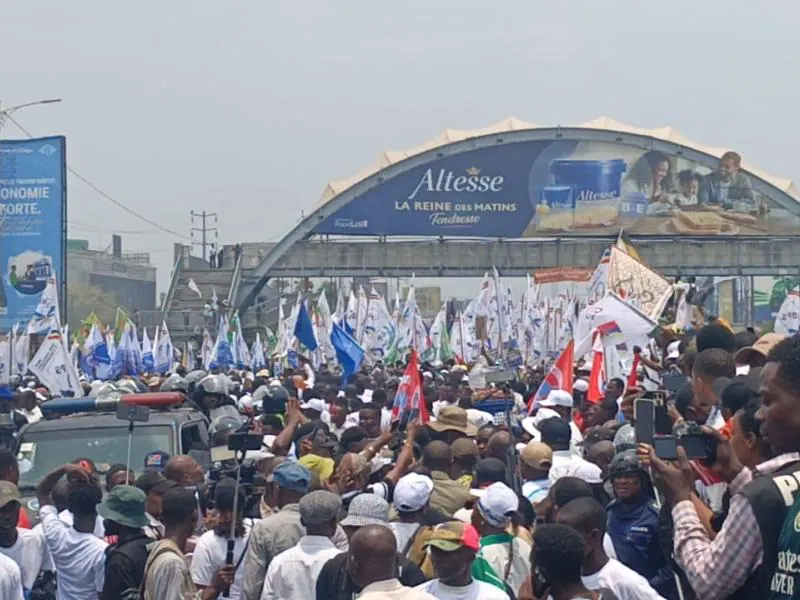
On September 22, thousands of militants and sympathizers of the Union for Democracy and Social Progress (UDPS) and its allies took part in a march in Kinshasa, the capital city of the Democratic Republic of the Congo. The march, which started at the 11th street in Limete, ended at the Cabu bridge, where Augustin Kabuya, the Secretary General of UDPS, addressed the crowd. The march was organized in support of the country's institutions, a law on the referendum, and the national dialogue announced by President Felix Tshisekedi.
According to Augustin Kabuya, the march was a response to a previous demonstration organized by the Coalition for the Defense of Article 64 (C64), a group that opposes the government's actions. Kabuya claimed that the large turnout was a demonstration of the majority support that President Tshisekedi enjoys in the country. He also emphasized the opposition's right to challenge the government's decisions while asserting the ruling party's right to support the President's actions.
The march was also an opportunity for Kabuya to express support for a constitutional change. He called on President Tshisekedi to take into account the will of the people, as expressed during the march, and to work towards changing the Constitution. Kabuya cited Article 5 of the Constitution, which states that the government must take into account the will of the population. He emphasized that the people want to see a change in the Constitution.
The UDPS march was not the only recent demonstration in Kinshasa. A week earlier, the C64 had organized a march, which was widely covered by foreign media. Kabuya seemed to be responding to those reports, which he claimed gave the impression that the opposition had more support than the ruling party. He asked foreign media to find a new term to describe the large turnout at the UDPS march.
The government's decision to allow the march to take place was seen as a sign of tolerance. The Kinshasa city government had authorized the march, which was seen as a test of the government's commitment to freedom of assembly. The march passed peacefully, with no reports of major incidents.
President Tshisekedi has been working to consolidate his power since taking office. He has announced a national dialogue, which aims to bring together different stakeholders to discuss the country's challenges. The UDPS march was seen as a show of support for the President's initiatives. Kabuya emphasized that the party is committed to supporting the President's actions and to working towards the country's development.
The march also highlighted the ongoing debate about the Constitution. There have been calls for a constitutional change to allow the President to serve a second term. Kabuya's comments seemed to suggest that the UDPS is pushing for a change to the Constitution. The issue is likely to be a contentious one, with different groups holding different views on the matter.
Key points
- The UDPS march was a show of support for President Felix Tshisekedi and his initiatives.
- The march was also a demonstration of the party's support for a constitutional change.
- The government's decision to allow the march to take place was seen as a sign of tolerance.