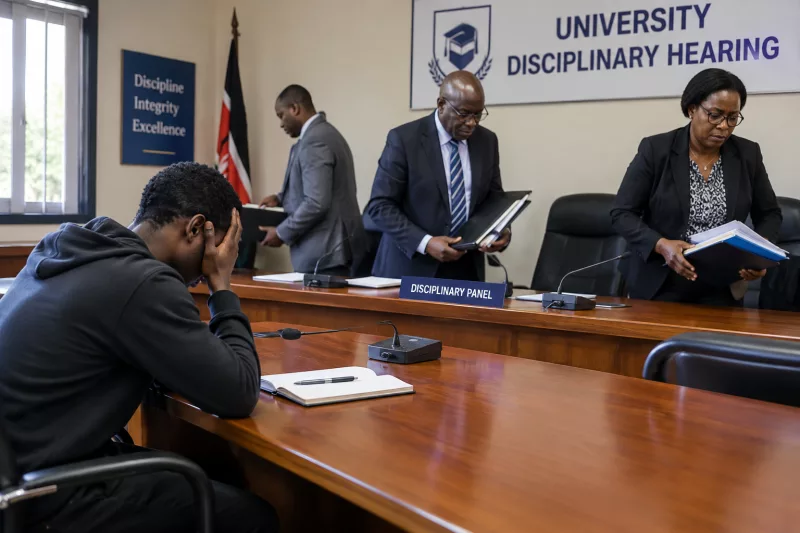
A significant number of university students in Kenya are facing an uncertain academic future due to a backlog of thousands of unresolved disciplinary appeals. According to the Commission for University Education (CUE), 2,718 student disciplinary appeals filed between 2022 and 2025 remained open and unresolved. This backlog has raised concerns about the impact on students' academic progress and potential graduation delays.
The University Statistics Report 2025 shows that universities recorded 11,016 appeals during the four-year period, with 7,178 successful, 1,120 failed, and 2,718 remaining open. The unresolved cases account for nearly a quarter of all appeals recorded during that period. In 2025, universities recorded 3,017 appeals, with 1,773 successful, 328 failed, and 916 remaining open. CUE noted that the 2025 figure may not represent the outcome of all cases filed that year due to pending appeals at the time of data extraction.
CUE has expressed concerns about the delays in resolving disciplinary appeals, citing the importance of having appeals handled within a reasonable timeframe. The Commission describes the right to appeal a disciplinary verdict as a "fundamental element of procedural fairness in university governance". To address the backlog, CUE wants universities to resolve disciplinary appeals within 90 days of filing, with institutional compliance rates reported annually through the Universities Management Information System (UEMIS).
The high rate of successful appeals has raised questions about the quality of first-instance disciplinary decisions. CUE's data shows a 65.2 per cent overall success rate between 2022 and 2025, with the rate rising from 43.1 per cent in 2022 to 67.8 per cent in 2023 and peaking at 78.1 per cent in 2024 before falling to 58.8 per cent in 2025. The Commission suggests that universities should view a high appeal success rate as a reason to examine the quality of their disciplinary processes.
Students with open appeals face an "uncertain academic status" as they cannot graduate, transfer to another institution, or re-enroll in affected units until their appeals are resolved. CUE notes that prolonged delays can be particularly devastating to students from lower-income backgrounds, who may be unable to absorb the financial consequences of waiting for an appeal to be determined. Unresolved appeals can extend beyond an administrative dispute and interfere directly with a student's overall career progression.
The proposed 90-day timeframe for resolving disciplinary appeals could provide a benchmark against which the number of delayed appeals is measured. CUE's recommendation comes as student disciplinary cases remain high, with 3,017 student behavior-related cases reported in 2025, submitted by 65 institutions through UEMIS, down from 3,361 in 2024. The Commission emphasizes the need for universities to prioritize resolving disciplinary appeals to mitigate the impact on students' academic futures.
The backlog of unresolved disciplinary appeals has significant implications for students, institutions, and the education system as a whole. As CUE continues to monitor the situation, universities are expected to take steps to address the backlog and ensure that disciplinary appeals are resolved in a timely manner. By doing so, students can avoid delayed graduation, transfer institutions, or re-enroll in affected units, ultimately ensuring that their academic progress is not unduly hindered.
Key points
- CUE wants universities to resolve disciplinary appeals within 90 days of filing.
- 2,718 student disciplinary appeals filed between 2022 and 2025 remained open and unresolved.
- The backlog of unresolved appeals can interfere directly with a student's overall career progression.