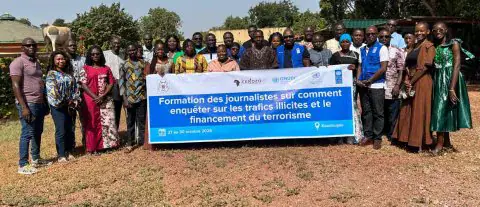
The Cellule Norbert Zongo pour le journalisme d’investigation en Afrique de l’Ouest (CENOZO), in collaboration with the United Nations Office on Drugs and Crime (UNODC) and the United Nations Development Programme (UNDP), organized a four-day workshop in Koudougou. The training, which took place from October 27 to 30, 2026, aimed to equip journalists with the skills needed to investigate illicit trafficking and terrorism financing. Thirty journalists participated in the workshop, which was opened by Blaise Zongo, director of cabinet to the governor.
The training is part of a project titled “Édification d’une paix durable: appui au renforcement des capacités du Burkina Faso à comprendre, prévenir et contrer la menace du financement du terrorisme.” The project aims to strengthen Burkina Faso's capacity to effectively combat terrorism financing and restore social cohesion. The project recognizes the crucial role that journalists play in identifying and exposing illicit networks that support terrorism financially. Journalists have the responsibility to shed light on the complex mechanisms that finance terrorism.
According to Blaise Zongo, journalists play a vital role in promoting transparency, seeking truth, and informing citizens. Through their investigations, journalists contribute to exposing criminal networks, illicit financial circuits, and practices that fuel insecurity. Their work strengthens accountability, informs public debate, and supports national efforts to prevent and combat terrorism. The training aims to enhance participants' knowledge of terrorist financing methods, improve their investigation techniques, and familiarize them with financial data analysis tools.
The training also focuses on enhancing journalists' online safety and security. Arnaud Ouédraogo, coordinator of CENOZO, noted that the session aims to equip journalists with the skills to produce information that will provide authorities with greater clarity on illicit financial flows. The goal is to enable journalists to understand the phenomenon, uncover mechanisms, and raise awareness among the population. The training features expert facilitators, including Sandrine Sawadogo, who emphasized the importance of rigor in handling financial data.
Sandrine Sawadogo highlighted the need for journalists to verify information and seek out official sources to ensure accuracy. She noted that financial data often requires careful analysis and that journalists must be meticulous in their research. The training provides journalists with practical tools and techniques to conduct in-depth investigations. Participants have expressed satisfaction with the training, citing its relevance to their work.
Simplice Zongo, a journalist who participated in the training, praised the workshop as "very relevant" to current events. He noted that the training has provided him with valuable tools and skills to enhance his investigative reporting. The training has equipped participants with the knowledge and skills needed to tackle complex topics such as illicit trafficking and terrorism financing.
The collaboration between CENOZO, UNODC, and UNDP reflects a concerted effort to strengthen the capacity of journalists to contribute to the fight against illicit trafficking and terrorism financing. The training is a significant step towards promoting a safer and more stable environment in Burkina Faso. By enhancing journalists' skills and knowledge, the project aims to foster a culture of transparency and accountability.
Key points
- Journalists play a crucial role in identifying and exposing illicit networks that support terrorism financially.
- The training aims to enhance participants' knowledge of terrorist financing methods and improve their investigation techniques.
- The project recognizes the importance of collaboration between journalists, authorities, and international organizations in combating illicit trafficking and terrorism financing.