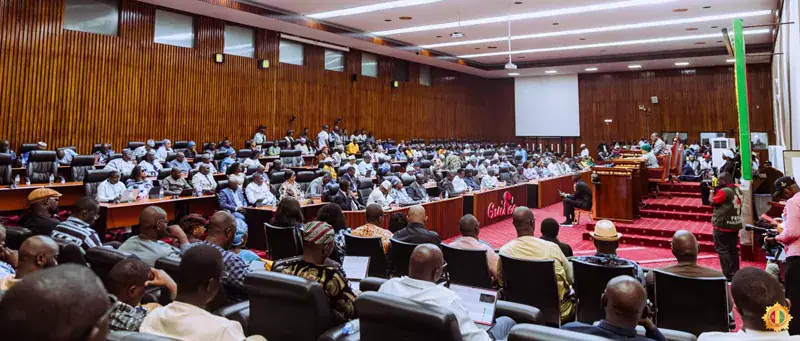
The execution of projects funded by foreign loans in Guinea has raised concerns within the National Assembly. During a plenary session on October 31, 2026, devoted to examining and adopting the revenue portion of the 2026 budget bill, Honorable Fabara Koné, rapporteur of the Finance Committee, revealed that 30 out of 55 projects have a disbursement rate of less than 10%. This has sparked worries about the country's ability to absorb foreign financing for development projects.
According to the Finance Committee, the 55 projects in question represent a total portfolio of $4.45 billion. However, only $1.055 billion has been disbursed so far. The committee's report highlighted that 19 projects have not recorded any disbursement, while 11 others have a disbursement rate of less than 10%. This situation is concerning, as it may lead to Guinea paying significant commitment fees on undisbursed resources.
The low absorption of mobilized financing has prompted the Finance Committee to recommend urgent measures to the government to accelerate project execution. The committee suggests that the government establish a precise calendar for disbursement and project execution, complete with deadlines, measurable objectives, and clear identification of responsibilities for ministerial departments and project management units.
The Finance Committee also recommends evaluating the commitment fees supported by the state for undisbursed financing and establishing a regular monitoring mechanism to track progress. This would involve periodic communication of results to the National Assembly. The goal is to prevent mobilized resources for national development from becoming an additional financial burden on public finances without effective returns for the population.
The situation is particularly worrying, as foreign financing is a crucial lever for infrastructure development and project financing in Guinea. The slow execution of projects may lead to delays in public investment and expose the state to additional financial costs. The National Assembly is urging the government to take swift action to address this issue and ensure effective use of foreign financing.
In response to this challenge, the government is expected to take concrete steps to improve project execution and disbursement rates. This may involve strengthening project management capacities, enhancing coordination among ministerial departments, and improving communication with foreign partners. The National Assembly will likely monitor progress closely to ensure that the recommended measures are implemented effectively.
Ultimately, the effective execution of foreign-financed projects is crucial for Guinea's development and economic growth. The country's ability to absorb and utilize foreign financing will have a significant impact on its infrastructure development, poverty reduction, and overall economic prospects. The National Assembly's recommendations aim to ensure that Guinea maximizes the benefits of foreign financing and achieves tangible results for its population.
Key points
- Thirty out of 55 Guinea projects funded by foreign loans have a disbursement rate of less than 10%.
- The low disbursement rate may lead to Guinea paying significant commitment fees on undisbursed resources.
- The National Assembly has recommended urgent measures to the government to accelerate project execution and improve disbursement rates.