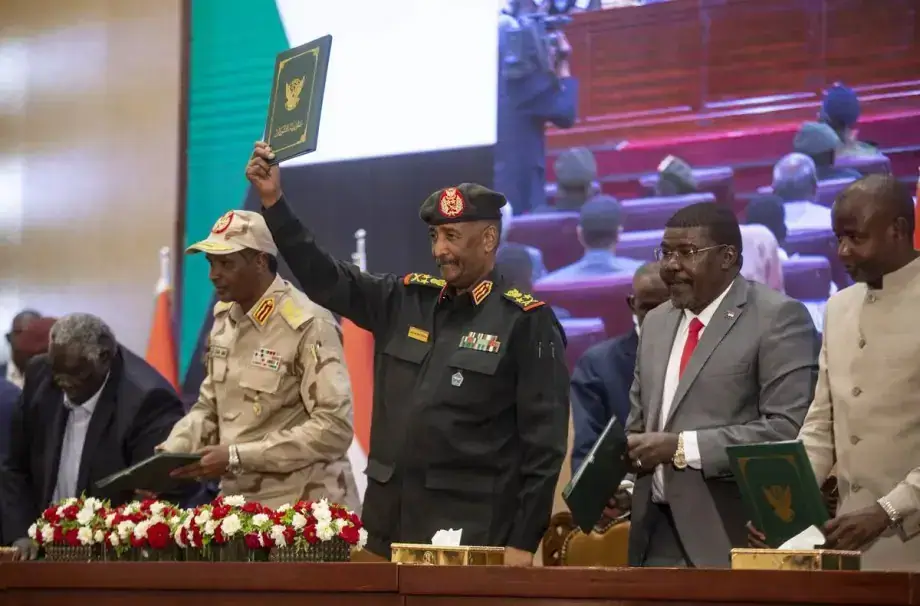
The war in Sudan, which began in April 2023, has presented significant challenges to African mediation efforts. Despite the African Union's (AU) initial optimism, with then-AU Commission chair Moussa Faki Mahamat calling it a 'prototype' for 'African solutions to African problems', the conflict has persisted. Over three years later, crucial diplomacy is taking place through international processes, including in Jeddah, Washington, and via the Quad, comprising the US, Saudi Arabia, the UAE, and Egypt.
African countries have not been absent from these efforts. On September 23, current AU Commission chair Mahmoud Ali Youssouf co-chaired the first joint meeting of the Quad and Quintet with US envoy Massad Boulos. The Quintet includes the AU, Intergovernmental Authority on Development (IGAD), the UN, European Union, and the League of Arab States. However, the question remains as to why African diplomacy has struggled to make a more significant impact.
Part of the answer lies in the African mediation itself, with competing initiatives and disagreements over leadership and approach. Khalid Omer Yousif, a former Minister of Cabinet Affairs in Sudan's civilian-led transitional government, notes that both sides intend to keep fighting until they achieve their political objectives. He believes that neither side has concluded that negotiations offer more than the battlefield.
Liesl Louw-Vaudran, Senior Adviser to the International Crisis Group, points to IGAD's attempt to bring the two sides together in December 2023. Although IGAD announced an unconditional ceasefire and face-to-face meeting between General Abdel Fattah al-Burhan and Rapid Support Forces (RSF) commander Mohamed Hamdan Dagalo, the meeting never happened due to disagreements over terms and format.
Louw-Vaudran attributes the lackluster response by the AU and IGAD to institutional weakness. She notes that Moussa Faki established an expanded mechanism to deal with Sudan, but the AU Peace and Security Council believed it undermined its authority. Meanwhile, IGAD leaders had differing opinions on the crisis, hampering progress.
African states are not necessarily neutral in the conflict, with their positions shaped by national security concerns, border stability, economic interests, and relationships with external powers. For example, Egypt has close ties to the Sudanese Armed Forces (SAF) and regards developments in Sudan as a national security issue. Conversely, the UN has reported evidence of a transnational network supplying the RSF with weapons and equipment.
The mediators face challenges due to limited leverage and competing interests. Dr. Yassine El Yattioui notes that the AU and IGAD possess significant regional legitimacy but lack coercive mechanisms, financial incentives, or military instruments to alter the calculations of the belligerents. Ultimately, the success of mediation efforts depends on building trust and finding a solution that addresses the root causes of the conflict.
Key points
- African mediation efforts in Sudan face challenges due to competing initiatives and institutional weaknesses.
- The conflict has persisted despite African Union's initial optimism and international diplomacy efforts.
- Limited leverage and competing interests hinder the effectiveness of African mediators.