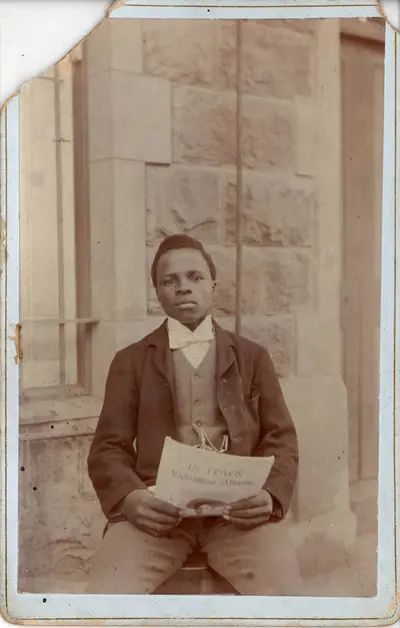
Solomon Tshekisho Plaatje was born into a Barolong family, where indigenous systems of authority and Christian missionary networks intersected. His early education, facilitated by the London Missionary Society, equipped him with literacy in Setswana and English. This foundation would later position him as a "linguistic bordercrosser," mediating between linguistic repertoires, cultural formations, and political alignments in a structurally unequal colonial context. Plaatje's roles as a court interpreter, journalist, novelist, and political activist for the South African Native National Congress (SANNC) further solidified his position as a key figure in the struggle against colonialism.
Plaatje's journalistic career began in 1901 when he joined Koranta ea Becoana, a Setswana and English weekly in Mafikeng, and edited it from 1902. He later started Tsala ea Becoana in Kimberley, renamed Tsala ea Batho in 1912. These publications were groundbreaking, as they used written Setswana to convey news and political arguments to Batswana readers, a departure from the missionary-dominated literary landscape. Plaatje's journalistic voice was not limited to the newsroom; his letters to white newspapers, officials, and sympathizers abroad read like opinion pieces, stating grievances, providing evidence, and calling for action.
The black press faced significant challenges, including limited financial resources and readership. Plaatje's letters, however, proved to be a powerful tool, allowing him to reach a wider audience and influence public opinion. He used correspondence and orthography as weapons of resistance, deliberately choosing his words and language to challenge colonial authority. Plaatje's publishing endeavors were also marked by strategic decisions, such as using the inherited missionary spelling in Sechuana Proverbs to ensure legibility and readership.
Plaatje's work was characterized by a deep understanding of the power dynamics at play in colonial South Africa. He used courtesy as a strategy, writing with polish and quoting colonial laws and promises back to officials. This approach allowed him to make demands that could not be easily dismissed. During his 1914 trip to London with the SANNC delegation, Plaatje's correspondence kept the cause alive between meetings and maintained pressure on those who would have preferred to forget.
Plaatje's literary contributions, including Sechuana Proverbs and A Sechuana Reader, showcased his commitment to promoting African languages and cultures. He collected 732 proverbs, providing literal translations and equivalents in six European languages, to demonstrate the equality of Setswana thought with European thought. His translation choices were careful, balancing fidelity to the original text with the need to convey cultural nuances. Plaatje's work on Shakespearean translations, including Diphosophoso and Julius Caesar, further underscored the capabilities of Setswana as a literary language.
Plaatje's legacy extends beyond his literary contributions, as he helped shape the settlement of African languages and their written forms. His work on Setswana orthography and spelling reforms continues to influence contemporary debates. Today, his letters, proverbs, and literary works remain essential reading, offering insights into the complexities of colonialism and the power of language as a tool of resistance. Dr. Otshepeng Moletsane, a Setswana lecturer at the University of South Africa, has highlighted the importance of collecting, digitizing, and teaching Plaatje's works to carry his written legacy forward.
As South Africa continues to grapple with issues of language, culture, and identity, Plaatje's life and work serve as a powerful reminder of the importance of linguistic and cultural autonomy. His unwavering commitment to promoting African languages and challenging colonial authority has left an indelible mark on the country's literary and cultural landscape. As a writer, journalist, and activist, Plaatje's unyielding pen continues to inspire new generations of writers, scholars, and activists.
Key points
- Plaatje used letters as a form of journalism to challenge colonial authority and promote African languages and cultures.
- He deliberately chose his language and orthography to ensure legibility and readership, while also challenging colonial power dynamics.
- Plaatje's legacy continues to influence contemporary debates on language, culture, and identity in South Africa.