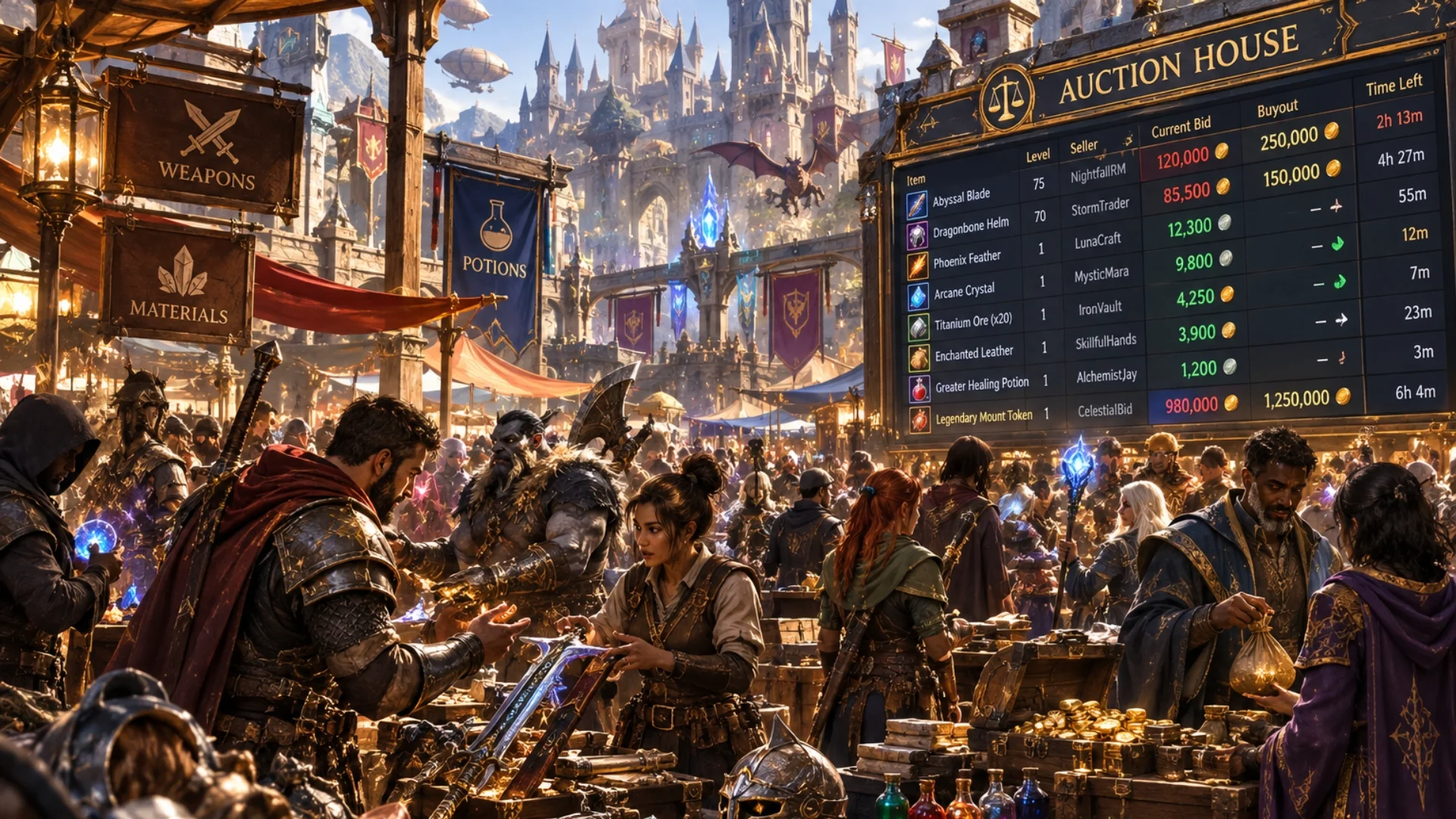
In online role-playing games, thousands of players share a virtual economy, leading to complex interactions and market dynamics. A recent article by Ifeanyi Ibeh highlights the fascinating aspects of these shared economies, where prices form, bargains disappear, and speculators emerge. The economies of these games are shaped by the interactions of players, who create a working market without external direction. This phenomenon is particularly notable in massively multiplayer online role-playing games (MMORPGs), where players can trade goods and services with each other.
The design of these virtual economies relies on two key elements: faucets and sinks. Faucets create value, such as when a monster drops coins or a quest rewards players with currency. Sinks, on the other hand, remove value, such as repair bills, travel fees, and crafting costs. Game designers must balance these two elements to maintain a stable economy. If faucets produce too much value, the economy may experience inflation, while too many sinks can leave players feeling poor. This delicate balance is crucial to creating a realistic and engaging game world.
One of the most interesting aspects of shared economies in online games is the emergence of player-driven markets. When game developers relinquish control over pricing, players take on the role of buyers and sellers, determining the value of goods and services. In well-designed MMORPGs, the price of rare items is determined by the agreement of the most impatient buyer and the most patient seller. Players quickly learn to exploit market trends, buying at quiet hours and selling after big updates. This player-driven economy can lead to a more immersive and realistic game world.
The concept of virtual economies has attracted the attention of economists, who have studied the market dynamics of online games. In 2001, Edward Castronova studied the virtual world of EverQuest and found that players earned an average of $3.42 per hour, with a GNP per capita comparable to that of Russia or Bulgaria. Castronova's study also revealed extreme inequality among players, with some accumulating vast wealth while others struggled to make ends meet. This inequality can be attributed to the different playstyles of players, with some focusing on trading and others on combat.
The phenomenon of gold farming has also emerged in online games, where players sell in-game currency and items for real money. This practice has created a hidden industry, with hundreds of thousands of people employed in China and other countries. Game developers have tried to combat gold farming by banning accounts and offering official ways to exchange time for premium currency. However, the underlying demand for gold and items drives the industry, and developers continue to struggle with this issue.
Long-running online worlds face unique challenges, such as inflation and crashes, as veteran players accumulate wealth and newcomers struggle to enter the market. When updates make rare materials more accessible, their value can plummet, causing crashes that hurt some players but benefit others. Game developers must navigate these challenges to create a fair and engaging economy. In Nigeria, the growing game development scene is debating how to build sustainable studios that focus on the business side of play.
Ultimately, a shared economy in online games works only when players believe the rules are fair. Game designers must carefully manage the economy, adjusting the balance of faucets and sinks to create a realistic and engaging experience. Players also have a role to play, as their actions can affect the market and the experience of others. By understanding the complex dynamics of virtual economies, game developers can create more immersive and engaging game worlds.
Key points
- The economy of online role-playing games is shaped by the interactions of thousands of players, leading to complex market dynamics and emergent behaviors.
- Game designers must balance the creation and removal of value in the game economy to maintain stability and prevent inflation or poverty.
- The phenomenon of gold farming has created a hidden industry, with significant implications for game developers and players alike.