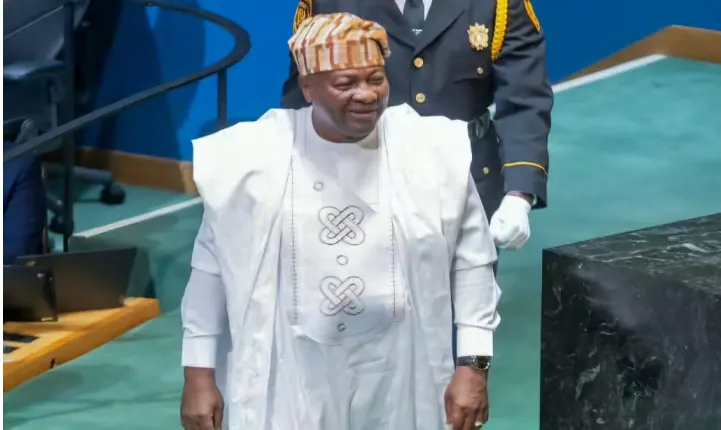
President John Mahama of Ghana recently attended the 81st United Nations General Assembly, where his attire sparked interest among observers. He wore an elegant white three-piece agbada, a traditional West African garment. The agbada has a history in presidential fashion in Ghana, dating back to the Limann administration in the 1980s. This garment is part of a broader tradition of flowing prestige-robes found across West Africa. Mahama's choice of attire was seen as a way to draw from a recognisably West African sartorial vocabulary.
The agbada worn by Mahama featured a large Adinkra symbol embroidered prominently down its front: Kramo Bɔne. This symbol is part of a fuller expression, Kramo bɔne amma yɛanhu Kramo papa. Researchers have studied Mahama's attire, finding that his clothing constitutes a deliberate leadership narrative. A study published in the African Identities journal examined Mahama's 2025 inaugural clothing and found that his attire communicated spiritually anchored leadership. The researchers also interviewed Mahama's designer, who described the President as an active "co-creator" of the inaugural outfit.
The Adinkra symbol, Kramo Bɔne, has been interpreted as a symbol of hypocrisy. According to Adolph Hilary Agbo's book, Values of Adinkra and Agama Symbols, Kramo Bɔne is explicitly identified as a symbol of hypocrisy. The underlying proverb states that a bad Muslim has made it difficult for one to recognise a good one. This symbol raises a problem of discernment, warning against taking people simply at face value. The moral reach of Kramo Bɔne extends beyond its literal reference, associating with the pretentious and hypocritical nature of some people.
Mahama's UN address highlighted the gap between profession and practice in international relations. He spoke about Gaza and the application of international law, questioning an international architecture in which Africa remains without permanent representation on the Security Council. He demanded reparatory justice for slavery and warned that Africa will not remain a passive arena for a new scramble for resources. Mahama insisted that the UN Charter must prevail over a world in which "might makes right".
The relationship between Mahama's spoken and visual rhetoric is fascinating. His attire and speech both conveyed a message about leadership and accountability. Researchers have approached Mahama's inaugural clothing through visual rhetoric and semiotics, interpreting the Adinkra symbols as persuasive communication. These studies reinforce the interpretation that Mahama's attire was a deliberate choice, meant to convey a specific message.
Multiple studies have examined Mahama's attire, including his 2025 inaugural outfit. These studies, published in various journals, treat Adinkra as capable of communicating political philosophy, ethical leadership, national identity, and cultural continuity. The studies draw on a range of participants, including traditional leaders, fashion designers, museum curators, and cultural preservationists.
The prominence of Kramo Bɔne on Mahama's UNGA attire is difficult to dismiss as mere decoration. Previous scholarship has established that Mahama has deliberately participated in constructing the symbolic language of his attire. As such, his choice of attire and symbol can be seen as a deliberate attempt to convey a message about leadership and accountability.
Key points
- President Mahama's UNGA attire featured a large Adinkra symbol, Kramo Bɔne, which has been interpreted as a symbol of hypocrisy.
- Researchers have found that Mahama's attire constitutes a deliberate leadership narrative, communicating spiritually anchored leadership.
- Mahama's UN address highlighted the gap between profession and practice in international relations, questioning the relationship between principles and realities of international power.