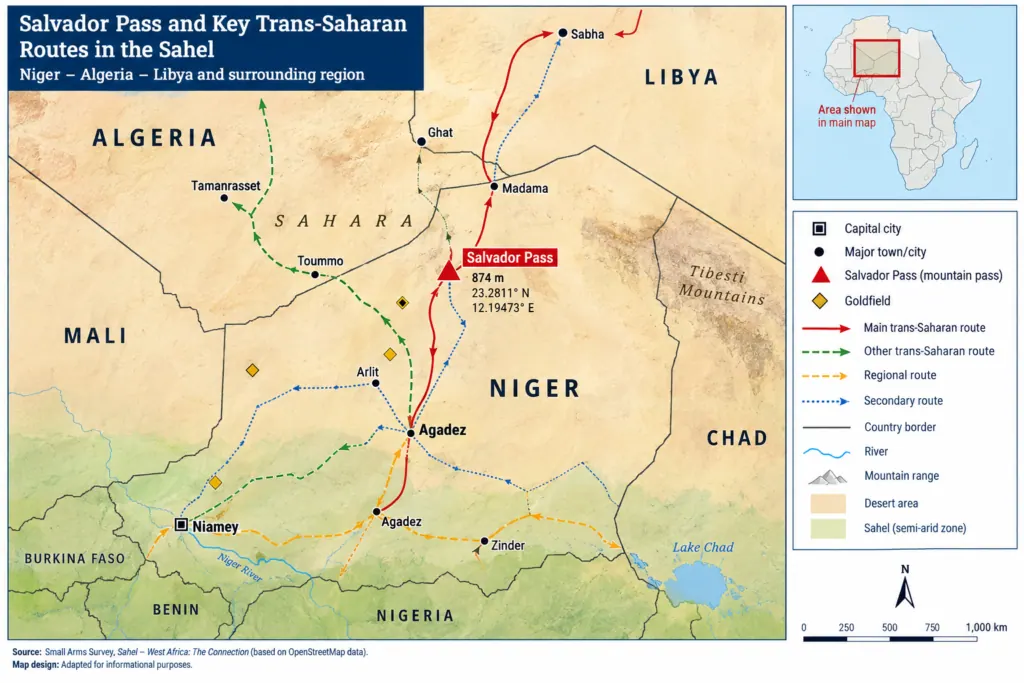
The Salvador Pass, a desert gap where Libya, Niger, and Algeria meet, has been a major smuggling corridor in the Sahara for centuries. Colonial cartographers labelled it 'Passe de Salvador' on old French military survey maps, but its origin remains unclear. The pass has been used to move fuel, cigarettes, migrants, and weapons between three states. Its obscurity is significant, as it has emerged as an active arena for warlords and great-power politics, with implications extending beyond southern Libya.
The region's political landscape is complex, with Libya having two rival governments since its 2014 civil war. A UN-recognised administration in Tripoli is led by Abdulhamid Dbeibah, while a rival administration in the east, based in Benghazi, is controlled militarily by Khalifa Haftar. Niger has been run by a military junta since a 2023 coup, led by General Abdourahamane Tiani. Chad's government, headed by Mahamat Idriss Déby, emerged from a similar military transition after his father's death in 2021. Algeria, the region's traditional power broker, is a civilian-led state with its own long-standing interests in Sahelian stability.
A failed prisoner exchange between Libya and Niger has revealed the complex interests converging on the Salvador Pass. The exchange involved Rifi Bahr al-Din, a detained Libyan figure held in Niger since mid-2025, and Mahmoud Saleh, head of the National Front for the Liberation of Niger, who was in eastern Libyan custody. The agreement failed when Niger's military authorities transferred Bahr al-Din to the rival government in Tripoli, led by Abdulhamid Dbeibah. Saleh was released from eastern Libyan custody around the same time.
The failed prisoner exchange has significant implications for the region. For Benghazi, it was a message that Niger's ruling council under Abdourahamane Tiani no longer saw the Haftar camp as its main channel into Libyan and Sahelian affairs. Instead, Niamey appears to be hedging its bets with Tripoli. The episode is an early instance of a pattern that recurs throughout this account: actors in this corridor keep extending themselves toward partners who have already begun hedging them.
A Nigerien liaison cell travelled to Benghazi and met directly with Saddam Haftar and senior eastern Libyan officials, discussing the movement of armed groups across the Libya-Niger-Chad triangle and coordination against shared adversaries. One file discussed in this channel involved a joint operation against fighters loyal to Mohamed Ouardougo, a rival Chadian-Libyan militia commander operating in the same border region. The proposed budget for the operation was roughly $7 million, and discussions included intelligence-sharing, coordinated raids, and possibly drone strikes using eastern Libyan aircraft.
The fate of the Nigerien liaison cell following the collapse of relations remains unclear. Libyan sources confirm that the cell existed, but its current status is unknown. The episode highlights the complex web of alliances and rivalries in the region, with multiple actors pursuing their interests in the Salvador Pass. Russia, which backs actors on more than one side, is also a key player in the region.
The Salvador Pass has become a battleground for Libya's warlords, with implications extending beyond southern Libya. The complex network of interests converging on the pass involves Libyan, Nigerien, Chadian, and Russian actors. The region's stability is crucial for the entire Sahel region, and the situation in the Salvador Pass will likely continue to have significant repercussions for the region.
Key points
- A failed prisoner exchange in Niger reveals a complex network of Libyan, Nigerien, Chadian, and Russian interests converging on a Sahara smuggling corridor.
- The Salvador Pass has emerged as an active arena for warlords and great-power politics, with implications extending beyond southern Libya.
- A Nigerien liaison cell travelled to Benghazi and met directly with Saddam Haftar and senior eastern Libyan officials, discussing joint operations against shared adversaries.