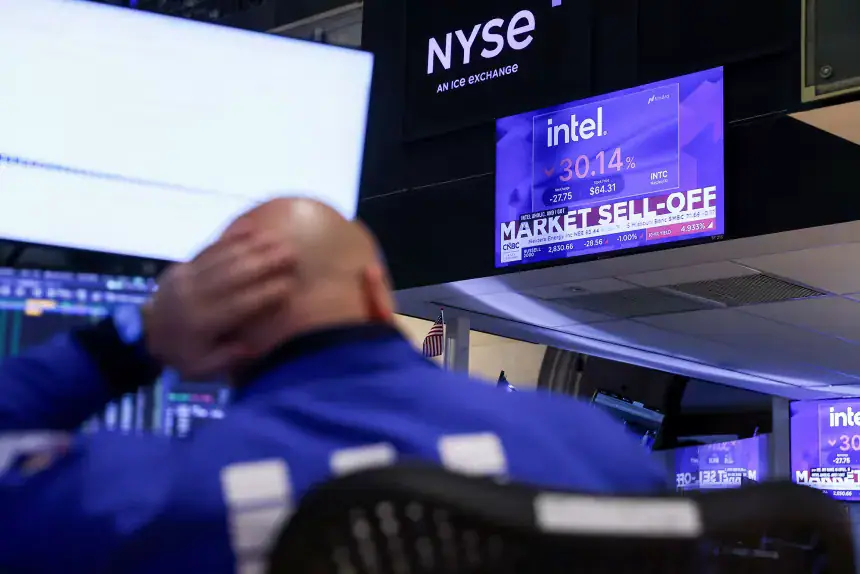
The recent stock market downturn, with significant declines in major tech companies like Google, Intel, Amazon, and Meta, has raised concerns about the profitability of artificial intelligence (AI) investments. Despite this, the bond market continues to support Big Tech's debt financing for AI infrastructure, with lenders lining up to take on this debt. According to JPMorgan, spending on AI has reached $1.6 trillion since 2023 and is expected to hit $1 trillion annually for the next decade.
The AI investment model involves significant upfront spending on infrastructure, including data centers, servers, chips, power, labor, and building materials. Hyperscalers like Google, Amazon, Microsoft, and Meta then monetize these investments over a period ranging from three months to two years later. This requires borrowing large sums of money upfront, with Goldman Sachs estimating that these four hyperscalers alone will finance around $250 billion worth of bonds this year, peaking at 35% of their spending next year.
Despite concerns about the sustainability of this spending spree, bond market investors appear willing to lend to AI companies. Goldman Sachs estimates that there is $510 billion of available investment-grade debt for the biggest hyperscalers, more than double their expected borrowing by the end of the year. Private investment funds, venture funds, and private equity firms are also ready to support the AI buildout with trillions of dollars in "dry powder."
However, not all companies in the AI space are on solid ground. Neoclouds, which rent out computing to other businesses, are highly indebted and have credit situations that are starting to look precarious. Companies like CoreWeave, with bond yields surging to 15% this month amid mounting losses, may be vulnerable to a shakeout. Elon Musk has predicted a "guppy-level death" for some neoclouds.
In contrast, hyperscalers appear to be winners, with cloud revenue growing 50% in the second quarter and huge contract backlogs. Their capacity to absorb higher borrowing costs and support high prices has helped revenue surge 19% over the past 12 months. The advent of agentic AI has also sent demand exploding, with requests from agents consuming 15 times as many tokens as human-initiated requests.
The concern is that the cost of borrowing could become unwieldy, changing the economics that are currently working for AI. If negative sentiment in the stock market bleeds into the bond market, sending bond yields higher and raising borrowing costs for AI companies, it could impact the sector's growth. The bond market works best when there is an end in sight, but uncertainty about when AI companies will turn a profit could give lenders pause.
Despite these concerns, the outlook for AI and the big companies' finances looks strong, according to JPMorgan's global market strategist Stephanie Aliaga. Warning signs would include a downshift in businesses' AI usage, cheaper pricing, or fewer customer commitments, but none of these are being seen yet. The real question about AI is how much longer the bond market will sustain the nonstop spending spree, ultimately dictating whether AI turns into a success or a bust.
Key points
- The bond market's support for Big Tech's AI investments is crucial to the sector's growth.
- Hyperscalers like Google and Amazon appear to be well-positioned to weather the challenges, but smaller players may be vulnerable.
- The uncertainty about when AI companies will turn a profit could impact the bond market's willingness to lend.