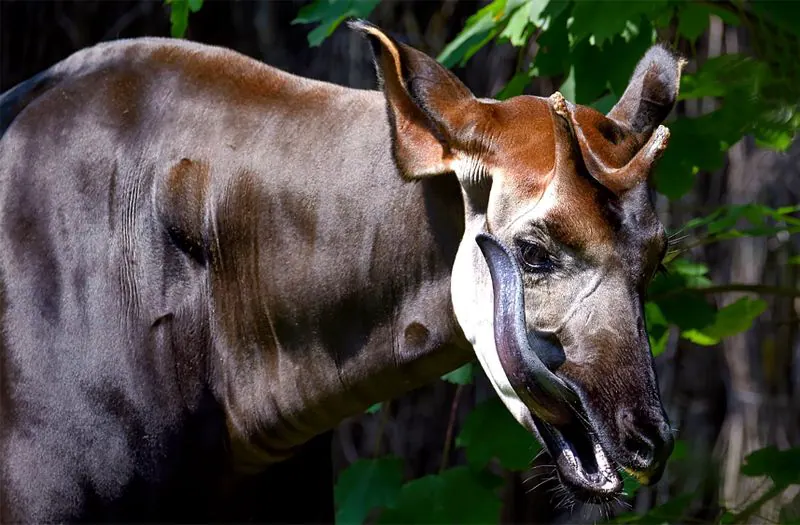
The okapi, often referred to as the "African unicorn," was first discovered by Western scientists in 1901. This unique creature, found in the dark and humid depths of an African rainforest, has a distinctive appearance, with a long blue-black tongue, huge ears, and stripey black-and-white hindquarters. The okapi's remarkable beauty and unique coloring have captivated those who have seen it. Italian explorer and filmmaker Attilio Gatti described the okapi as "Beautiful" after helping to capture one in a jungle pit trap in 1934.
Dr. Simon Pooley, author of "Discovering the Okapi," notes that the okapi's beauty and his boyhood memory of an okapi photograph inspired him to write a book about these animals. Pooley, who grew up in the Ndumo Game Reserve in KwaZulu-Natal, was disappointed to find relatively little information about the history of okapis, particularly in English. He set out to research and write a book that he had always wanted to read about okapis. Pooley's book acknowledges that many Africans had known about and hunted okapis for thousands of years in the Ituri forest region of the Democratic Republic of Congo.
The okapi's history in captivity is marked by high mortality rates. Between 1901 and the 1970s, hundreds of okapis died in transit or shortly after arrival in zoos due to poor husbandry and health challenges. The okapi's unique needs were not well understood, leading to deaths caused by factors such as seasickness, moldy food, and lack of straw in capture crates. However, as husbandry improved, survival rates gradually increased. Today, around 180 okapis live in zoos worldwide, but they are descended from a small pool with little genetic variation.
Conservation efforts have been underway to protect the okapi in its natural habitat. The first significant wildlife reserve for okapis was established in 1925, now known as Virunga National Park. In 1992, the 1.3 million hectare Okapi Wildlife Reserve was created in their largest remaining stronghold. The reserve was proclaimed a Unesco World Heritage Site in 1996 but was listed as a heritage site in danger due to threats such as civil war, gold mining, and the bushmeat trade.
The okapi faces numerous threats, including habitat fragmentation, poaching, and human-wildlife conflict. According to the US-based Okapi Conservation Project, over two million people have moved to the surrounding Ituri region due to conflict-induced migration, increasing pressure on the forest. Illegal mining and agriculture have also contributed to the decline of okapi numbers. The species was officially declared "endangered" in the International Union for Conservation of Nature Red List in 2013.
Conservation groups have pulled out of the area for safety reasons, and funding support has been cut. The Okapi Conservation Project and other organizations are working to protect the okapi and its habitat. However, more needs to be done to address the ongoing threats and ensure the long-term survival of this unique species. The okapi's decline is a concern for conservationists, who are calling for increased efforts to protect this iconic animal.
The okapi's story serves as a reminder of the importance of conservation and the need to protect endangered species. Dr. Pooley's book aims to bring the okapi "back into focus" from its recent obscurity. By raising awareness about the okapi's plight, conservationists hope to inspire action and ensure the survival of this incredible creature. The okapi's future remains uncertain, but with continued conservation efforts, there is hope for this majestic animal.
Key points
- The okapi was declared "endangered" in the International Union for Conservation of Nature Red List in 2013.
- Over two million people have moved to the surrounding Ituri region due to conflict-induced migration, increasing pressure on the forest.
- The okapi's decline is attributed to various threats, including habitat fragmentation, poaching, and human-wildlife conflict.