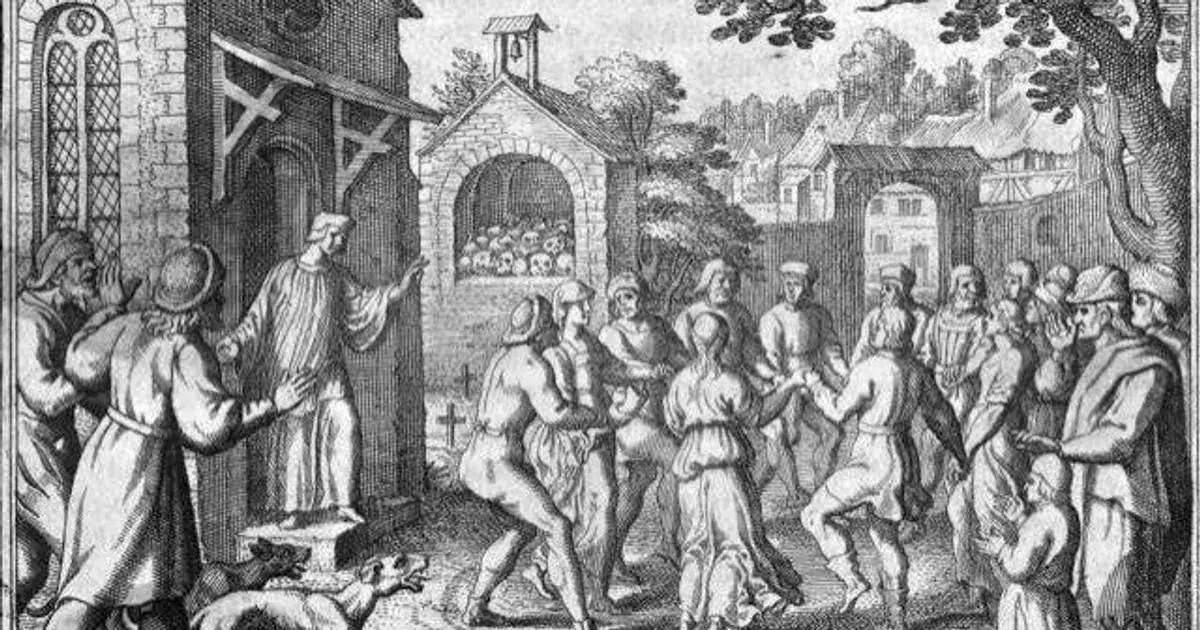
In July 1518, a strange phenomenon occurred in Strasbourg, then part of the Holy Roman Empire, where hundreds of people began dancing uncontrollably and without music. The dancers, including women and men, hopped, leaped, and twisted through streets, houses, and public spaces, with some reportedly dancing for days or weeks without rest. The outbreak started with a single woman, Frau Troffea, who began dancing on July 14, 1518, and within a week, about 34 people had joined her.
By the end of the month, the number of dancers had grown to around 400, with some collapsing from exhaustion and others reportedly dancing themselves to death. The authorities were alarmed and consulted physicians, who attributed the cause to an excess of "hot blood" in the body, a medical explanation rooted in the belief that illness resulted from imbalances in the body. Some locals believed the event was a divine punishment from St Vitus, an early Christian martyr from Sicily, for their failure to appease him.
Historians have proposed various theories to explain the dancing plague, including mass psychogenic illness and ergot poisoning. Mass psychogenic illness is attributed to the hardships endured by Strasbourg, including extreme poverty, diseases like smallpox and syphilis, and starvation due to crop failures. Ergot poisoning, caused by a fungus that infects grains, produces toxic compounds that can cause hallucinations, convulsions, and other neurological symptoms.
However, the ergot poisoning theory has significant weaknesses, as it cannot account for the particular behavior described in Strasbourg. Severe ergotism can also cause gangrene, yet historical accounts do not clearly document the characteristic blackening of affected limbs. The authorities attempted to quell the situation by arranging spaces for the afflicted to continue moving and bringing in musicians and professional dancers, but the plan was unsuccessful.
The event exposed a clash between medical and religious understandings of illness, as historian Lynneth J. Miller explains in her 2017 study, Divine Punishment or Disease? Mediaeval and Early Modern Approaches to the 1518 Strasbourg Dancing Plague. The outbreak was eventually subsided after authorities banned public dancing and musical performances, and the afflicted were taken to a St Vitus shrine.
The Strasbourg outbreak was not an isolated example of dancing mania, as similar episodes had been reported in parts of Europe before 1518, including a major outbreak in the Rhine region in 1374. In modern times, people have voluntarily danced for extraordinary lengths of time in attempts to enter the Guinness World Records, such as India's Srushti Sudhir Jagtap, who danced for 127 hours in 2023.
The mysterious dancing plague of 1518 remains a topic of interest and debate among historians and medical researchers, who continue to explore the possible causes of this bizarre event. Despite various theories, the exact cause of the dancing plague remains unknown, leaving behind a puzzling chapter in recorded history.
Key points
- The dancing plague of 1518 in Strasbourg remains a mysterious event with various theories, including mass psychogenic illness and ergot poisoning, but no definitive explanation.
- The event started with a single woman, Frau Troffea, and eventually grew to hundreds of people dancing uncontrollably.
- The outbreak had significant impacts on the community, with some dancers collapsing or dying, and the authorities attempting to quell the situation.