The recent UN General Assembly address exposed the widening gap between political narratives and geopolitical realities in the Middle East. Israeli Prime Minister Benjamin Netanyahu's address was a prime example, as he attempted to shape the discussion around Israel as a permanently threatened state. His argument follows a familiar pattern: Israel is surrounded by enemies determined to attack it, and therefore its military actions are presented as an extension of its right to self-defence.
However, the geopolitical position of the Middle East is entering a phase in which military narratives alone can no longer define political reality. Military force cannot permanently change political realities, and facts imposed through force cannot automatically shape political narratives. Israel's military capabilities may be far superior to those of many regional actors, but military superiority does not necessarily translate into the ability to permanently redesign borders, settlements or the political future of the West Bank.
The discussion surrounding the United States has become equally significant, with Tucker Carlson arguing that the conflict involving Iran is not merely about preventing a nuclear capability but about reducing Iran's strategic strength to a level where it cannot pose a major threat to Israel. He also highlighted the Gulf states' growing trust deficit, as countries that have invested heavily in stability, infrastructure and economic transformation increasingly expect security to protect their investments.
The continued presence of American forces in the Middle East has generated debate over financial and strategic costs. When Carlson raised the issue with Donald Trump, his response that ultimately “we are all going to die anyway” was presented humorously, but the underlying policy question remains serious. Continued American military backing for Israel, without a parallel diplomatic strategy, risks becoming a factor that sustains escalation rather than resolving it.
Iran, meanwhile, must also understand the limits of its strategic threshold. Its responses and diplomatic positioning have demonstrated considerable strategic calculation, but rigid decisions can carry significant costs. Iran has warned that if neighbouring states participate in attacks against it, they could become targets as well. Politically, however, this risks reinforcing the narrative promoted by Netanyahu and Trump that Iran is the regional aggressor.
The Gulf states, including Saudi Arabia, have invested heavily in economic diversification, such as Saudi Arabia's Vision 2030, and another regional war threatens business, tourism, investment and long-term development. Their objective is therefore increasingly to remain outside direct military confrontation. Iran must recognise this red line as well, as a country already facing economic pressure cannot afford to lose its remaining regional relationships.
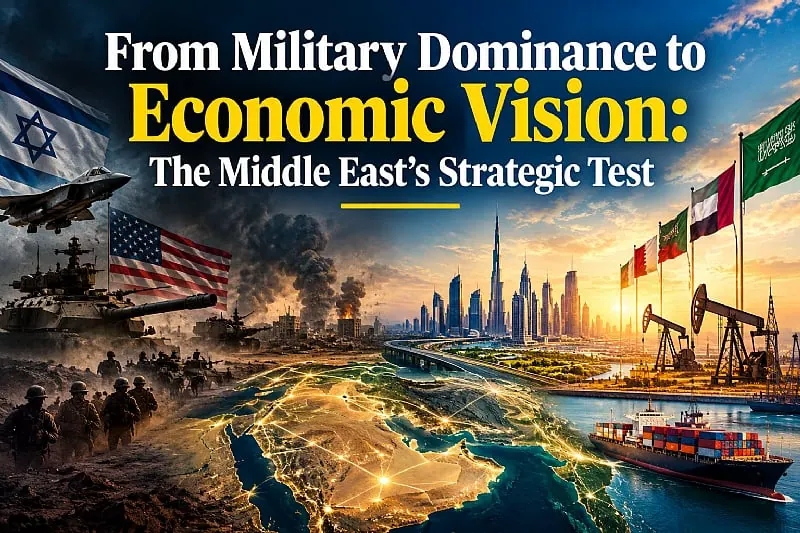
The emerging Middle East presents a fundamental choice: continued dependence on military deterrence or a transition toward economic integration, diplomacy and strategic autonomy. Military power can destroy infrastructure, alter calculations and create temporary deterrence—but it cannot by itself create lasting political legitimacy. The region's future may ultimately be determined not by who can fire the most missiles, but by who can build the most sustainable political and economic order after the missiles stop.
Key points
- The Middle East's strategic test is a choice between continued dependence on military deterrence and a transition toward economic integration, diplomacy and strategic autonomy.
- The Gulf states are increasingly opting for diplomacy, economic stability and regional de-escalation.
- Iran faces a delicate calculation in its diplomatic positioning, with significant costs for rigid decisions.