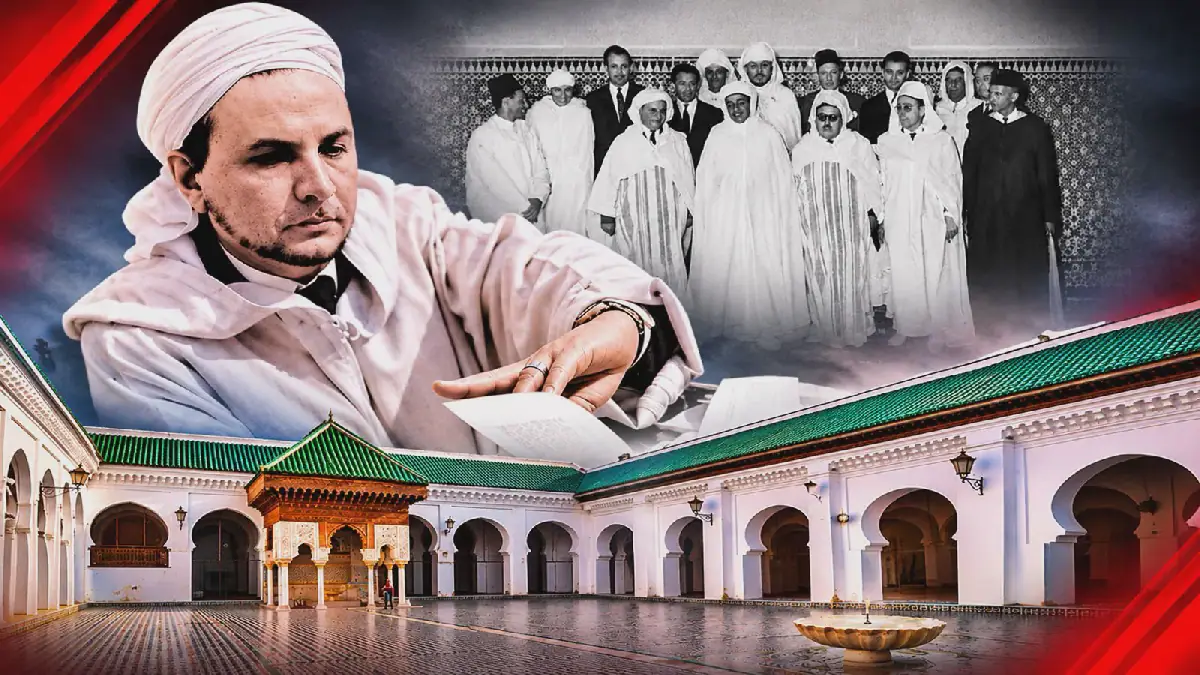
Allal Fassi was born in the ancient city of Fez, Morocco, on January 20, 1910, to a family of Arab and Muslim descent. His early life was marked by a strong educational foundation, with his initial studies taking place in a traditional Quranic school, where he learned the principles of Islam and Arabic writing under the guidance of Faqih Muhammad al-Khamisi. Fassi's academic pursuits continued at the Free Arabic School in Fez, where he studied the fundamentals of Islam and Arabic.
In 1920, Fassi joined the University of Al-Qarawiyyin, one of the oldest and most prestigious Islamic institutions of higher learning in the world. There, he studied under renowned scholars, including Ibn al-Arabi al-Alawi, al-Husayn al-Iraqi, and Abu Shu'ayb al-Dukali, and obtained a degree in Islamic law and a certificate of authorization to teach. This academic background shaped Fassi's vision for Morocco's future, which emphasized the importance of returning to Islamic values and principles as a means of achieving national independence and progress.
The issuance of the Berber Dahir in 1930 by the French colonial authorities marked a turning point in Fassi's life and career. The Dahir aimed to divide Morocco along linguistic and cultural lines, separating the Amazigh community from the Arab community and subjecting the former to laws that were not based on Islamic principles. Fassi strongly opposed this move, viewing it as an attempt to undermine Morocco's cultural and national identity. His opposition to the Dahir led to his arrest and subsequent ban from teaching.
Following his arrest and ban from teaching, Fassi continued to be involved in Morocco's nationalist movement. He traveled to Spain and Switzerland, where he met with other nationalist leaders, including Prince Shakib Arslan. In 1934, Fassi returned to Morocco and founded the first workers' union in 1936, as well as the secret National Action Bloc in 1937, which would eventually become the Istiqlal Party. These activities led to his exile to Gabon and later the Congo by the French authorities.
During his exile, Fassi continued to advocate for Morocco's independence and worked closely with other nationalist leaders. He returned to Morocco in 1946 and played a key role in the country's struggle for independence. In 1949, the French authorities banned him from entering Morocco, and he was forced to reside in Tangier, which was then an international zone. Fassi continued to be involved in Morocco's nationalist movement, advocating for the country's independence and self-determination.
In 1953, when King Mohammed V was exiled to Madagascar, Fassi called for the Moroccan people to rise up against French colonial rule. After Morocco gained its independence in 1956, Fassi returned to the country and became a key figure in the Istiqlal Party. He served as a minister of state for Islamic affairs and was a member of the committee that drafted the country's Islamic law code. Fassi also taught at the University of Al-Qarawiyyin and other institutions.
In addition to his political and academic career, Fassi was a prolific writer and author. He wrote over 30 books on various subjects, including Islamic law, history, and politics. Some of his notable works include "The Objectives of Islamic Law and Its Virtues" and "A Defense of Islamic Law." Fassi passed away on May 20, 1974, in Bucharest, Romania, while on a diplomatic mission. His legacy continues to be felt in Morocco and beyond, with his ideas about the importance of Islamic values and national identity remaining influential to this day.
Key points
- Allal Fassi played a crucial role in Morocco's struggle for independence and advocated for the country's cultural and national identity.
- Fassi's vision for Morocco's future emphasized the importance of returning to Islamic values and principles as a means of achieving national independence and progress.
- He was a prolific writer and author, writing over 30 books on various subjects, including Islamic law, history, and politics.