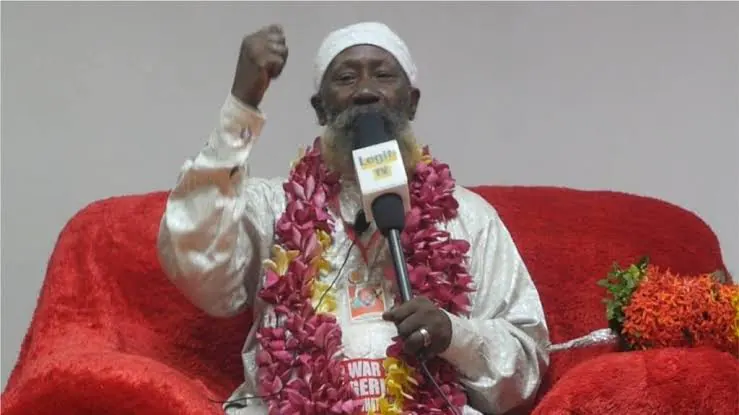
Born in 1947 in Obuasi, Ghana, to a Yoruba Muslim family, Mohamed Ajirobatan Ibrahim was educated in a Methodist school. His early life was a blend of influences, with roots in Oyo State and a childhood spent in Ibadan. This fusion of identities would later become a hallmark of his spiritual movement. Ibrahim's job with Nigeria Airways provided the catalyst for his transformation, giving him a passport to the world outside West Africa, particularly London.
In London, amidst the spiritual curiosity of the late 1970s, Ibrahim's life took a dramatic turn. According to accounts from his movement, on January 1, 1980, he received a divine revelation, with the mission to save humanity. When he returned to Nigeria in July 1980, Mohamed Ibrahim was gone, replaced by Satguru Maharaj Ji, the "Saviour of the New Age." He chose a path to influence that diverged sharply from conventional political or economic pursuits.
Upon his return, Maharaj Ji established the headquarters of his new movement in Lagos, calling it the One Love Family. It was explicitly not a church or a mosque, but a universal spiritual path that transcended the divisions of conventional religion. His teachings blended concepts from Hinduism and Christianity with Yoruba spiritual traditions, creating a syncretic faith that was uniquely Nigerian. His followers, known as "Premies," were encouraged to see beyond ethnic and religious identities.
The Nigeria of the 1980s was a country of immense social and economic turmoil, with years of military coups and economic instability leaving many people searching for certainty and meaning. In this spiritual vacuum, charismatic figures offered a different kind of hope. Maharaj Ji's message found fertile ground, with his central message one of love, peace, and the attainment of divine knowledge through him, the Living Perfect Master.
In 1987, the One Love Family established a 40-hectare settlement along the Lagos-Ibadan Expressway, known as the Satguru Maharaj Ji Village. This self-contained world had its own rules, rituals, and sacred geography, with followers adopting a vegetarian diet and wearing badges to show their loyalty. The community had its own gathering hall for spiritual activities, agricultural plots for self-sufficiency, and a calendar built around key dates in Maharaj Ji's life.
Fame and controversy grew in lockstep, with the title "Black Jesus" attracting both curious followers and intense scrutiny. Accusations against him and his movement included allegations of secret burials and murder, but he was acquitted in 2000. Throughout his incarceration, he reportedly received an average of 25 visitors a day. Despite his claims of divinity, Maharaj Ji was never above the laws of the land, as seen in his 2011 eviction from a property in Ibadan.
The movement survived, outlasting dozens of smaller spiritual groups that had long since faded. Maharaj Ji's endurance is the most remarkable part of his story, successfully transforming himself from Mohammed Ibrahim, the airline worker, into a spiritual icon. His legacy continues to provoke strong reactions, with some viewing him as a divine saviour and others as an eccentric cult leader.
Key points
- Satguru Maharaj Ji's movement, the One Love Family, established a unique spiritual path that blended concepts from various traditions.
- Maharaj Ji's claims of divinity and his establishment of a self-sufficient commune sparked controversy and intense scrutiny.
- Despite accusations and challenges, Maharaj Ji's movement survived, and he remains a significant figure in Nigeria's spiritual landscape.