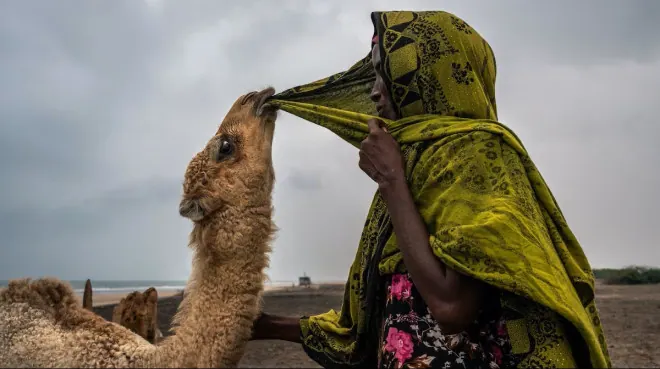
The camel holds a special place in Somali culture, particularly in the arid and semi-arid lands where it is a vital source of livelihood. For generations, Somali pastoralists have relied on the camel for milk, meat, and transportation. The camel's ability to withstand extreme temperatures and survive in harsh environments has made it an essential part of Somali life. According to Ahmed A. Hussein, a food scientist and expert in agro-processing, the camel is a "miracle on four legs" that has been a cornerstone of Somali survival.
In Somali culture, the camel is not just an animal but a symbol of pride and dignity. It is used to pay blood money to resolve clan feuds, given as bridal wealth, and immortalized in Somali poetry and work songs. The camel's significance extends beyond its practical uses, representing independence and self-sufficiency. Owning camels means that one can walk through the scrubland without being beholden to anyone, giving them a sense of freedom and autonomy.
The Quran also highlights the camel's significance, referring to it as a living sign of divine mercy and supreme intelligence. In Surah Al-Ghashiyah, Allah challenges human intellect to look at the camel's creation and understand its unique characteristics. The Quranic perspective on the camel emphasizes its ability to endure extreme heat and carry heavy loads, demonstrating God's kindness and mercy.
Recent scientific discoveries have confirmed the camel's unique characteristics, revealing its molecular and biological mechanics. Biochemists and geneticists have discovered that the camel's red blood cells are oval rather than round, allowing them to flow smoothly even when its blood thickens during extreme dehydration. The camel's dynamic body temperature and ability to suppress sweating have also been mapped, showing its remarkable adaptability to harsh environments.
Camel milk is another remarkable aspect of the camel's biology, containing unique single-domain antibodies, lactoferrin, and lysozymes that destroy harmful bacteria at ambient temperatures. Unlike cow's milk, camel milk requires no complex processing or artificial modifications, making it a complete and natural food source. Its nutritional benefits include high levels of Vitamin C, low allergen proteins, and easily digestible fat globules.
The camel's byproducts also have significant benefits, including its manure, which is expelled nearly dry and provides a low-smoke fuel for cooking fires in treeless plains. When combining traditional nomadic wisdom, Quranic teachings, and scientific breakthroughs, a profound harmony emerges, highlighting the camel's unique design and divine creation.
Ahmed A. Hussein, a food scientist and expert in agro-processing, has extensive international experience and qualifications from Cornell University and the University of Toronto. His article highlights the importance of recognizing the camel's significance in Somali culture and its potential benefits for food security and sustainable development.
Key points
- The camel is a vital source of livelihood in Somalia, providing milk, meat, and transportation in arid and semi-arid lands.
- The camel's unique characteristics, such as its oval red blood cells and dynamic body temperature, make it an remarkable example of evolutionary engineering.
- Camel milk is a complete and natural food source, requiring no complex processing or artificial modifications, and has significant nutritional benefits.