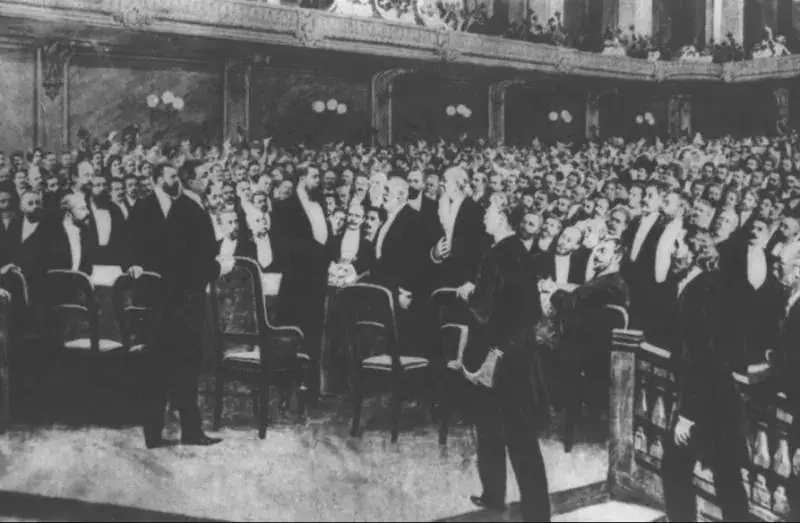
The concept of modern Zionism was born in 1897, when Theodor Herzl, an Austro-Hungarian journalist, proposed the establishment of a Jewish homeland in Palestine. This idea was presented at the First Zionist Congress in Basel, Switzerland, which took place from August 29 to 31, 1897. The congress brought together 200 participants from 17 countries, who discussed the orientation of the Zionist movement. Herzl's proposal was to create a Jewish state that would be recognized by other nations.
The idea of Zionism emerged in the context of the Dreyfus affair, a highly publicized scandal in France that led to a surge in anti-Semitism. Many Jews felt that they had failed to integrate into European society and that their assimilation efforts had been unsuccessful. Herzl's proposal was influenced by European nationalist movements and the desire for a Jewish homeland. His book, "The Jewish State," published in 1896, outlined his vision for a Jewish state.
The First Zionist Congress in Basel resulted in the formulation of the Basel Program, which defined the objectives of the Zionist movement. The program aimed to establish a Jewish homeland in Palestine, guaranteed by public law. The initiative received a mixed response in the press, with some newspapers supporting Herzl's vision as a genuine movement of liberation. The French newspaper, Le Constitutionnel, acknowledged the difficulties faced by Jews in Europe and saw the Zionist movement as a legitimate response.
Some newspapers, including the anti-Semitic newspaper La Libre Parole, supported Herzl's proposal, seeing it as a way to remove Jews from France. The newspaper published an interview with Max Nordau, a key figure in the Zionist movement, who acknowledged the influence of anti-Semitic writers on his thinking. However, this support was not universally welcomed, and some critics saw it as a tactical mistake.
The concept of Jewish nationalism sparked debate, including within the Jewish community. Zadoc Kahn, the Grand Rabbi of France, expressed reservations about Herzl's proposal, citing the difficulties of establishing a Jewish state and the potential risks of re-establishing a Jewish kingdom. Kahn emphasized the importance of separating religious and civil law, which had been a source of conflict in the past.
Some commentators saw the Zionist movement as a misguided response to anti-Semitism. Yves Guyot, a French journalist, argued in 1899 that the Zionist movement was a trap set by anti-Semites, who wanted to encourage Jews to leave Europe. Guyot saw the movement as a form of resignation to proscription, rather than a genuine solution to the problems faced by Jews.
The Zionist movement marked a significant turning point in Jewish history, as it redefined the concept of Jewish identity and nationhood. The movement's emphasis on a Jewish homeland in Palestine would go on to shape Jewish politics and identity for decades to come. The debate surrounding Zionism continues to this day, with many questioning its implications and consequences.
Key points
- Theodor Herzl's proposal to establish a Jewish homeland in Palestine marked the birth of modern Zionism.
- The First Zionist Congress in Basel in 1897 defined the objectives of the Zionist movement.
- The Zionist movement emerged in the context of rising anti-Semitism in Europe and the failure of Jewish assimilation efforts.