The United States and Iran are experiencing heightened tensions as the US presidential election approaches. According to reports, the White House has decided not to pursue a resolution to the conflict before the November 3rd elections, in which the Republican Party is expected to lose its congressional majority. Instead, the US plans to pursue a more aggressive approach after the elections.
Recent developments suggest a significant escalation of the conflict. A meeting between Iranian and US delegates at the 81st United Nations General Assembly yielded little progress. Iran has stated that no further negotiations are planned, while the US claims that new talks will occur to provide an opportunity for peace. US President Donald Trump has asserted that he has "all the cards" and that the Iranian regime is "desperate for an agreement."
The US has successfully restricted Iranian airlines by threatening to remove airports that receive them from the international dollar system. In response, Iranian negotiator Mohammad Bagher Ghalibaf warned that Iran may target infrastructure in the Middle East if its security is not guaranteed. Ghalibaf stated that if Iran's security is not ensured, "no infrastructure will be safe."
Iranian Foreign Minister Abbas Araghchi expects an official response from the US to Iran's conditions for reopening the Strait of Hormuz. The Strait has seen relative calm in recent weeks, with no US attacks on Iran since September 1st. However, US warships are frequently targeted in the region. The US has intensified economic sanctions on Iranian airlines and foreign companies that assist them.
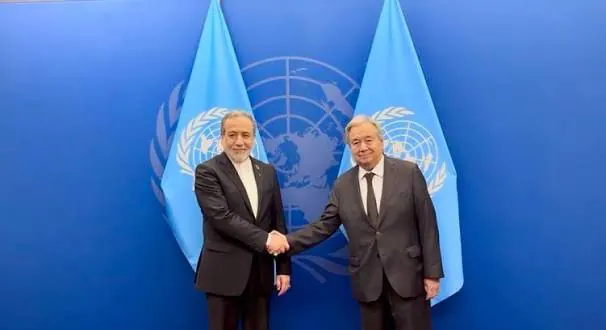
The US sanctions have forced major Iranian airlines to cancel international flights. As a last-ditch effort before the US elections, UN Secretary-General António Guterres is attempting to ease tensions between the two nations. Guterres met with Iranian Foreign Minister Abbas Araqchi on September 28th and appealed to both parties to maintain diplomatic efforts to achieve peace.
Guterres and Araqchi discussed the ongoing conflict and the Iranian proposal to reopen the Strait of Hormuz within seven days of an agreement. Although Iran has rejected this scenario, Guterres remains committed to finding a negotiated peace. The Secretary-General previously met with Iranian President Masoud Pezeshkian, urging him to resolve the conflict through dialogue and respect the freedom of navigation in the Strait of Hormuz.
The situation remains volatile as the US and Iran engage in indirect negotiations. The international community watches with concern as the conflict threatens to destabilize the region. The US and Iran must navigate a complex web of diplomatic efforts and economic sanctions to find a peaceful resolution.
Key points
- The US plans to escalate its conflict with Iran after the November elections.
- Iran has warned that it may target infrastructure in the Middle East if its security is not guaranteed.
- UN Secretary-General António Guterres is attempting to ease tensions between the US and Iran through diplomatic efforts.